Local SEO is filled with misinformation that can waste your marketing budget and keep your business hidden from your community. You likely hear conflicting advice about keywords, reviews, and proximity that stops you from actually getting more phone calls. This guide clears up six common local SEO myths and shows you the specific steps that actually move the needle for your business's visibility.
On This Page
- The distance trap and ranking beyond your front door
- The danger of keyword stuffing your business name
- Quantity versus quality in the review cycle
- The declining impact of standard citations
- Why more website pages won't automatically fix your maps ranking
- The myth of the set and forget Google Business Profile
- FAQs
The distance trap and ranking beyond your front door
Many business owners believe they can only rank for customers standing within a block of their office. They assume proximity is a fixed ceiling they cannot break. While Google does prioritize nearby results, you are not stuck. If a plumber in Phoenix only ranked for the street their warehouse was on, they would never get service calls from the rest of the valley. Local ranking factors are a balance of distance, relevance, and prominence. You can extend your reach by building localized authority through your content and backlinks.
To break the proximity barrier, you need to prove to Google that you are the most relevant option for a wide area. A dentist with 47 reviews who only lists their city in their footer will struggle compared to one who has dedicated pages for surrounding neighborhoods. Google looks for geographic signals across the web. If your business is mentioned on local news sites, neighborhood blogs, and chamber of commerce directories, your 'radius' of visibility expands. This is how a business in the suburbs starts appearing in search results for the main downtown area.
Your Google Business Profile should accurately reflect your service area, but do not lie about your physical location. If you use a fake office address to try and rank in a secondary city, Google will eventually suspend your listing. Instead, focus on gathering reviews from customers in those outlier areas. When a customer in a neighboring town leaves a review saying 'best AC repair in Scottsdale' and mentions their specific zip code, it signals to Google that you serve that area effectively. This organic expansion is what leads to a steady stream of phone calls from outside your immediate neighborhood.
Focus on 'entity' building rather than just proximity. This means making your business a known entity in your specific region. Mention local landmarks on your website, sponsor a little league team, and ensure your NAP (Name, Address, Phone number) data is consistent everywhere. When Google sees you are an active part of the local community, it feels more confident showing your business to users who are several miles away. This doesn't happen overnight, but consistent local signals will eventually widen your footprint on Google Maps. Want the full picture? Read our Ultimate Guide to Local SEO.
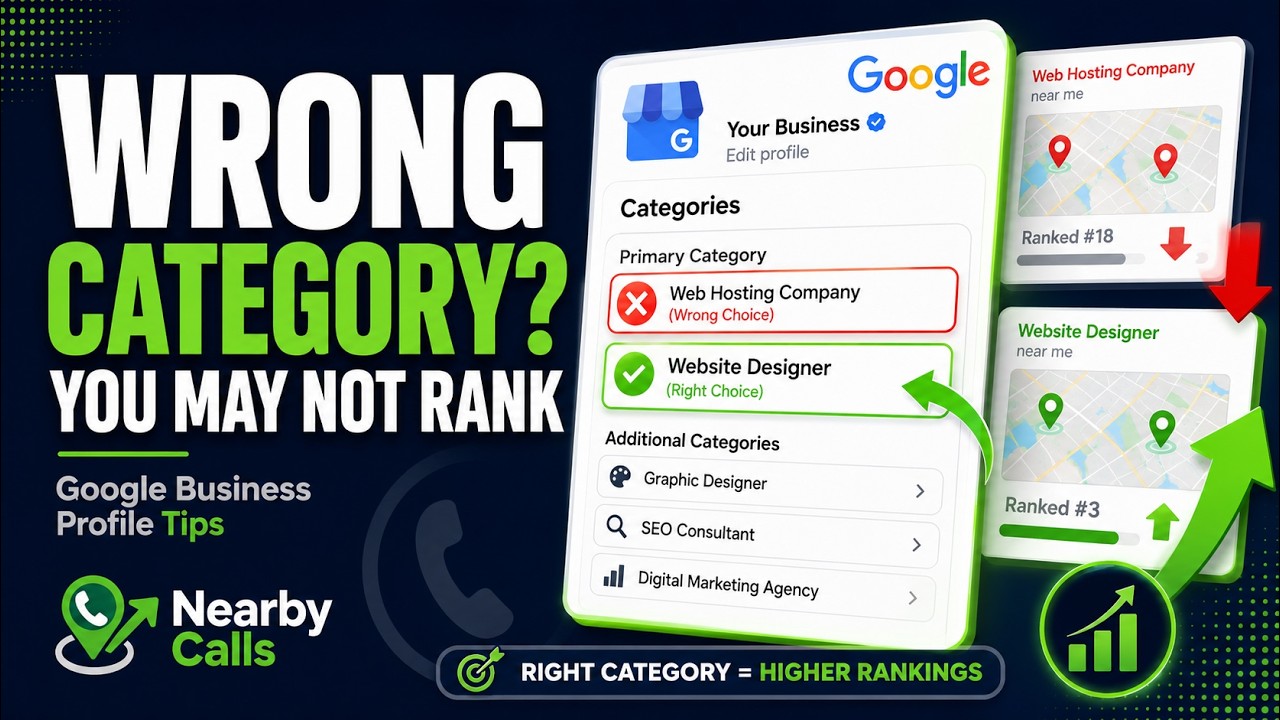
Fix Your Google Business Profile Categories to Rank Higher on Google Maps
Watch on YouTube
The danger of keyword stuffing your business name
You have probably seen competitors use names like 'Best Phoenix Plumber Emergency Drain Cleaning' even when their legal name is just 'Joe's Plumbing.' This is a common tactic because, historically, keywords in the business title had a massive impact on ranking. However, this is a direct violation of Google's Terms of Service and a risky long-term strategy. While it might give a short-term boost, it makes your listing a prime target for 'suggest an edit' reports from competitors. Once Google catches on, you face a hard suspension that can take weeks to resolve.
Relying on a stuffed name brand is a weak foundation for your local SEO. If your business depends on a TOS-violating name to get phone calls, you are one algorithm update away from zero revenue. A better approach is to use your legal business name and build your keyword relevance through your categories, services, and description. Google's AI is now smart enough to understand that 'Smile Bright Dental' is a dentist without needing the word 'dentist' repeated four times in the title. Trust the algorithm to understand your category and focus on building a real brand.
Consistency across the web is more valuable than a keyword-rich name that doesn't match your legal documents. If your Google listing says one thing, but your Yelp, Facebook, and local directory listings say another, you create 'data friction.' This confuses search engines and can actually lower your rankings. Your goal should be a clean, identical match of your real-world business name across every platform. This builds a 'trust graph' that Google uses to verify that you are a legitimate, high-quality business worthy of the top three spots in the Map Pack.
If you truly want to pivot your name for SEO reasons, do it legally. File a DBA (Doing Business As) for the keyword-rich name and update your signage and official documents. If you have the paperwork to back it up, Google will usually allow it. But for most owners, it is simpler and more effective to stick to your brand name and focus on getting high-quality reviews. Genuine customer feedback containing service keywords carries significant weight without the risk of being banned from the map entirely. Related reading: What Is Local SEO?.
Warning: Edit sensitive fields carefully.Changing your primary category, business name, address, or phone number can push your profile back into an unverified state and temporarily unpublish it from Google Search and Maps until you re-verify (often by video). Make category refinements deliberately, one change at a time, and avoid editing multiple sensitive fields in the same week.
Quantity versus quality in the review cycle
A common local SEO myth is that the person with the most reviews always wins. You might see a competitor with 500 reviews and feel like you can never catch up with your 50. However, Google values the quality, frequency, and content of reviews far more than the raw total. A dentist with 47 reviews that are detailed, recent, and include photos will often outrank a competitor with 200 stale reviews from three years ago. Google wants to see that your business is currently active and providing a good experience today.
The content inside the review matters for your local search visibility. When a customer writes, 'The plumber arrived on time and fixed my leaking water heater in Phoenix,' they are feeding Google's ranking engine. These 'keyword-rich' reviews help you show up for specific service searches. Instead of just asking for five stars, encourage your customers to mention what service they received. This provides the context Google needs to match your business with the right search queries, helping you get more qualified phone calls from people who need exactly what you offer.
Review velocity is the rate at which you acquire new feedback. If you suddenly get 50 reviews in two days after having none for a year, Google might flag them as fake and filter them out. A slow, steady stream of two or three reviews per week is much better than a massive spike followed by silence. This consistency signals to Google that your business is consistently reliable. It also keeps your 'Review Rating' fresh, which is a major factor in whether a user chooses to click the 'Call' button when they see your listing.
Negative reviews are not the end of the world. In fact, a profile with 100% five-star reviews can look suspicious to both Google and potential customers. The way you respond to a negative review is a powerful conversion tool. A professional, helpful response shows that you care about customer service. This builds trust with prospects who are reading your reviews. Don't stress about a single bad rating; focus on maintaining a high average and responding to everyone who takes the time to write to you. Related reading: Why SEO Takes Time.
The declining impact of standard citations
Years ago, local SEO was mostly about 'NAP' citations—getting your name, address, and phone number on hundreds of obscure directories. Many agencies still charge thousands of dollars for this service, claiming it is the key to ranking. The truth is that the power of low-quality directories has cratered. Having your business listed on a 'free business directory' site that no one ever visits doesn't help your ranking anymore. These sites have no authority, and Google knows they are often just used for spam.
Instead of broad citation volume, focus on 'hyper-local' and 'niche-relevant' citations. A link from your local Chamber of Commerce or a neighborhood blog is worth more than 50 links from generic directory sites. If you are a roofing contractor, being listed on a site dedicated to home improvement carries actual weight. These relevant links tell Google that expert sources in your specific field or city recognize you. This relevance is a core local ranking factor that drives real visibility and phone calls.
Data accuracy still matters, but you only need to worry about the 'Tier 1' aggregators and the major platforms like Google, Apple Maps, Bing, and Yelp. If your business moves or changes phone numbers, you must update these main sources immediately. Don't worry about updating a directory on page 10 of a search result that gets zero traffic. Focus your energy where the customers actually are. Spend your time making your Google Business Profile perfect rather than chasing hundreds of low-tier citations.
The real value of a citation today is the 'unlinked brand mention.' When your business is mentioned in a local news article about a charity event you sponsored, Google sees that. Even if there is no direct link to your website, the mention of your business name and city strengthens your local authority. This is a much more sophisticated way to build prominence than traditional citation building. It builds a narrative that your business is a pillar of the community, which Google rewards with higher local search visibility. Related reading: Why Rankings Fluctuate.
Why more website pages won't automatically fix your maps ranking
There is a misconception that if you just write a 2,000-word blog post every week, you will magically appear in the Map Pack. While content is important for traditional SEO, your Google Business Profile (GBP) and your website are two different animals that work together in specific ways. You cannot 'blog your way' into a top Google Maps position if your GBP is neglected or if you lack local backlinks. A plumber in Phoenix doesn't need 100 blog posts about the history of pipes; they need high-quality service pages and local trust signals.
Your website should support your local listing by providing deep information about your services and your service area. Each major service you offer should have its own page. For example, if you are a multi-service home pro, have separate pages for 'AC Repair,' 'Heating Installation,' and 'Duct Cleaning.' Link these pages directly from your Google Business Profile products or services section. This 'relevance loop' confirms to Google that you are an expert in these specific areas, which helps you show up when someone searches for those exact terms.
Local landing pages are more effective than generic blog posts. If you serve five different cities, create a unique page for each city that mentions local landmarks, community involvement, and specific projects you've completed there. Use real photos of your team working in those cities. This creates a much stronger local signal than a generic 'About Us' page. It helps your website rank for 'city + service' keywords while also providing the geographic context Google needs to rank your map listing in those specific areas.
Structure is more important than volume. Use Schema markup—a piece of code that helps search engines understand your business data—to clearly define your address, phone number, and operating hours. This 'LocalBusiness' Schema is a powerful way to feed data directly to Google. Instead of guessing, Google reads the code and sees exactly where you are and what you do. This technical alignment between your site and your map listing is what ultimately drives more phone calls from local search.
The myth of the set and forget Google Business Profile
Post updates at least once a week. These don't need to be professional advertisements. A simple photo of a recently completed job with a two-sentence description is enough. For a florist, this could be a 'Today's Special' bouquet. For a mechanic, it's a photo of a complex engine repair. These posts keep your listing looking alive to potential customers and provide Google with fresh text to index for local search. Active profiles often see a higher 'click-to-call' rate because they look more reliable and current.
Real photos of your actual work, team, storefront, and completed jobs are always the top priority — they build trust in a way stock imagery simply can't match. That said, keeping a steady stream of fresh photos on your profile matters more than holding out for perfect ones. If a stock image is what you have, use it: geotag it to your service area, give it a descriptive filename, size it correctly, and get it uploaded. A consistently active gallery is its own ranking signal, so fill the gaps with stock when you must, but keep replacing them with real photos of your business as you capture them.
Frequently Asked Questions
Related Articles
Get found, trusted, and called on Google.
Nearby Calls helps local businesses stay active on Google, collect more reviews, and generate more customer calls.
Learn About Nearby Calls