When customers need a service immediately, they rarely scroll past the first three results on Google Maps. Understanding how google maps rankings work is the difference between a busy phone line and a silent shop. You will learn the exact levers Google uses to decide which local businesses appear at the top and how to adjust your profile to capture that traffic.
On This Page
The three pillars of local ranking algorithms
Google uses three core criteria to rank your business: relevance, distance, and prominence. Relevance measures how well your Google Business Profile matches what someone is searching for. If a homeowner searches for emergency pipe repair, Google looks for a plumber in Phoenix who specifically mentions 24-hour service and emergency repairs in their business description and services list. You cannot rank for terms you do not mention, which is why your profile must be exhaustive.
Distance is the most rigid factor because neither you nor Google can move the searcher's physical location. If a user is standing on Main Street, Google prefers a dentist two blocks away over a highly-rated one five miles across town. However, distance is not the only factor. A business that is further away can still outrank a closer competitor if Google's algorithm decides that more distant business is significantly more relevant or prominent.
Prominence is essentially your digital reputation. It is based on information Google has about a business from across the web, such as links, articles, and directories. This is where your brand strength comes into play. A local bakery that has been featured in the city newspaper and has hundreds of check-ins on social media will have higher prominence. Google treats these external signals as votes of confidence, elevating businesses that the community clearly trusts and visits frequently.
To win in Google Maps, you must balance these three pillars. While you can't change your location, you have total control over your relevance through profile optimization and your prominence through review management and local mentions. When these three factors align, your business appears in the Local Pack, which is the box of three map results that appears at the top of standard Google search results. Want the full picture? Read our Ultimate Guide to Local SEO.
Strategic category selection and profile completeness
Your primary category is the single most important piece of data on your profile. If you run a landscaping company but set your primary category to 'Gardener,' you may miss out on high-intent searches for 'hardscaping' or 'lawn care.' Google uses this primary tag to define your business's core identity. You should choose the most specific category available that describes your main revenue driver, then use secondary categories to capture the rest of your service offerings.
Completeness signals to Google that you are an active, legitimate business. Profiles with missing phone numbers, blank descriptions, or no listed hours are viewed as less reliable. Imagine a dental clinic with 47 reviews that hasn't updated its holiday hours. Google might hesitate to show that clinic to a user on Christmas Eve, fearing the business is actually closed. A complete profile includes every service you offer, a detailed 'from the business' description, and a set opening date.
The description field is not a place for fluff; it is a place for keywords and location signals. Instead of saying 'We provide great service,' a plumber should write, 'We provide residential plumbing, water heater installation, and drain cleaning in North Phoenix and Scottsdale.' This tells the algorithm exactly where you operate and what you do. This clarity directly feeds into the relevance pillar, making it easier for Google to connect you with local callers.
Photos also play a massive role in ranking and click-through rates. Google’s Vision AI scans your images to verify what your business actually does. If you upload photos of your tools, your branded vans, and your completed projects, Google understands your business better. Users are also much more likely to click a profile with 50 high-quality photos than one with a single grainy shot of the storefront. More clicks lead to more data for Google, which often results in higher rankings over time. Related reading: What Is Local SEO?.
Warning: Edit sensitive fields carefully.Changing your primary category, business name, address, or phone number can push your profile back into an unverified state and temporarily unpublish it from Google Search and Maps until you re-verify (often by video). Make category refinements deliberately, one change at a time, and avoid editing multiple sensitive fields in the same week.
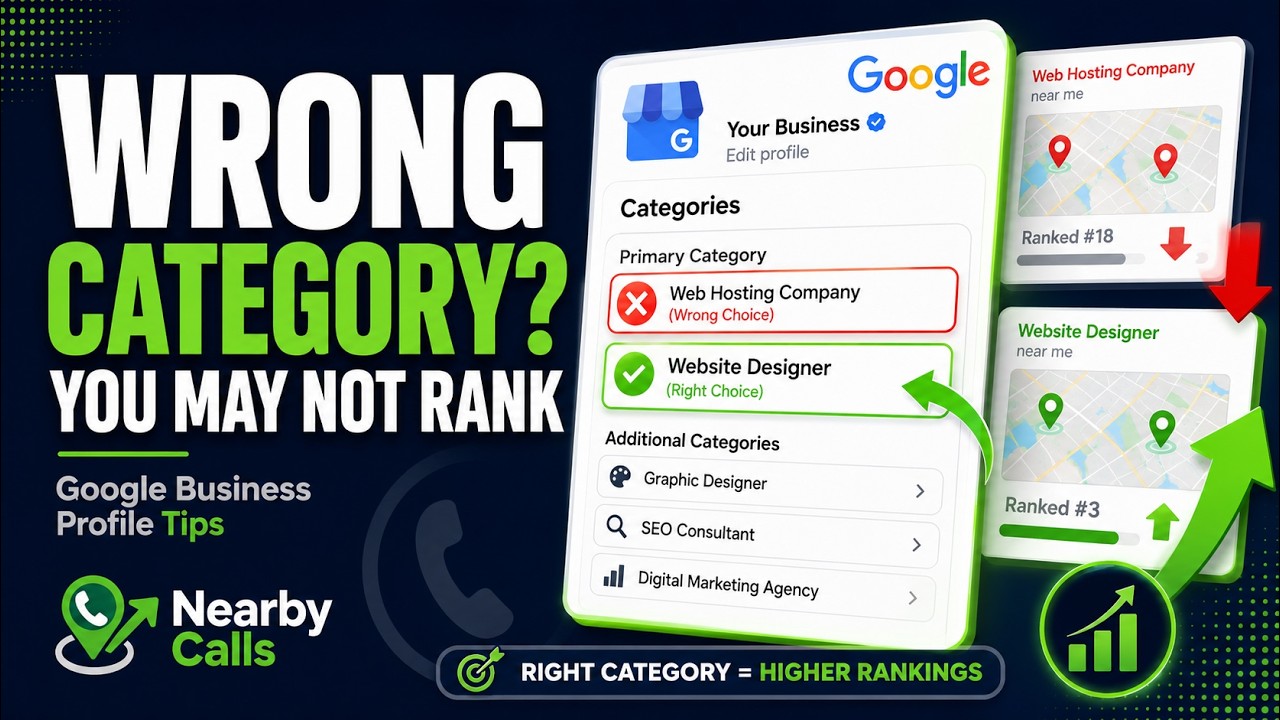
Fix Your Google Business Profile Categories to Rank Higher on Google Maps
Watch on YouTube
Review velocity and sentiment as ranking signals
It is a mistake to think that only your overall star rating matters. Google looks at review volume, review velocity, and the actual text within the reviews. Review volume is the total number of reviews; a dentist with 300 reviews has a significant prominence advantage over a competitor with 12. However, review velocity—the speed at which you acquire new reviews—is just as critical. If you got 50 reviews a year ago and none since, Google may view your business as stagnant or potentially closed.
The keywords your customers use in their reviews help you rank for specific services. When a customer writes, 'The best AC repair in Phoenix, they arrived on time,' they are doing your SEO for you. Google reads these reviews and associates your profile with those specific terms. You can encourage this by asking customers to mention the specific service they received. This creates a natural, ongoing stream of keyword-rich content that your business cannot generate on its own.
Responding to every review is non-negotiable for local SEO. When you respond, you demonstrate that the business is managed and attentive. It also provides another opportunity to naturally include service names. If a customer praises your 'emergency roofing repair,' your response should thank them for choosing your 'roofing company' for their 'emergency repair' needs. This reinforces the relevance of your profile to the algorithm.
Negative reviews happen, but how you handle them impacts your ranking potential. High-ranking profiles often have a few 1-star reviews because it looks authentic. Google's goal is to provide the best user experience, and a business that actively resolves complaints is seen as a safer bet than one that ignores them. Consistently getting new, positive feedback will eventually bury the occasional negative remark and keep your ranking trajectory moving upward. Related reading: Understanding Proximity.
The impact of local citations and NAP consistency
NAP stands for Name, Address, and Phone number. Google crawls the entire web to see if this information is consistent across third-party sites like Yelp, Yellow Pages, and local Chamber of Commerce directories. If your business is listed as 'Joe’s Plumbing' on Google but 'Joe’s Pipes & Drains' on Yelp, it creates data conflict. Google becomes less confident in your location and identity, which can cause your ranking to drop in favor of a competitor with perfectly aligned data.
Local citations act as digital footprints that verify your physical existence. For a plumber in Phoenix, being listed on a 'Best Arizona Contractors' list or a local neighborhood blog provides a high-quality backlink and a localized signal. These citations don't just drive direct traffic; they build the prominence score that helps you outrank businesses that only exist on Google Maps. The more high-quality, local sites that mention your business, the higher your authority becomes.
You should conduct a periodic audit of your digital footprint. Small errors, like an old suite number or a disconnected phone number on an obscure directory, can confuse search engines. Use tools or manual searches to find and correct these inconsistencies. Ensure that your website footer has the exact same NAP information as your Google Business Profile. This creates a loop of trust between your owned assets and third-party platforms.
Beyond just accuracy, the quantity of citations matters, but quality is more important. A single mention on a high-authority local news site is often worth more than fifty listings on low-quality 'link farm' directories. Focus your energy on getting listed where your actual customers might look, such as industry-specific directories or local community boards. This targeted approach builds a stronger foundation for your local search visibility. Related reading: Understanding Prominence.
On-page SEO for local landing pages
Your website and your Google Business Profile are not separate entities; they are deeply linked. Google uses your website's content to verify the information on your profile. If you want to rank for 'commercial HVAC installation,' your website needs a dedicated page for that service. This page should include your city name, service area details, and localized content such as projects you’ve completed in specific neighborhoods.
The technical structure of your site also plays a role. Using 'Local Business' schema markup—a piece of code that tells search engines exactly what your business is—helps Google parse your data accurately. This code highlights your operating hours, price range, and geographic coordinates. When Google can easily read your site’s data, it is more likely to trust your profile and rank it higher in the Map Pack.
Mobile optimization is vital because most Google Maps searches happen on phones. If a user clicks from your Map listing to your website and it takes ten seconds to load, they will bounce back to the search results. High bounce rates signal to Google that your site is not a good destination for users, which can negatively impact your Maps ranking. Your site must be fast, easy to navigate with a thumb, and have a clear 'Click to Call' button prominently displayed.
Local content goes beyond just mentioning your city. Writing about local events, common local problems (like how Phoenix heat affects car batteries), or local charity work helps establish your business as a pillar of the community. This hyper-local context distinguishes you from national franchises and provides Google with unique signals that you are the most relevant result for users in that specific area.
Monitoring performance and the user behavior loop
Google tracks how users interact with your profile, and this behavior influences your future rankings. If 50 people search for 'dentist' and 40 of them click on the third result instead of the first, Google will eventually swap their positions. This is known as Click-Through Rate (CTR). You can improve your CTR by having a compelling profile cover photo, a high star rating, and using 'Google Updates' to post weekly offers or news.
The 'Call' button is the ultimate conversion metric for most local businesses. Google keeps track of how many phone calls are generated through your profile. Higher call volumes indicate that your business is a popular and helpful result, which reinforces your ranking. To encourage more calls, ensure your phone number is correct and that you are using Google's messaging features to engage with customers who prefer texting.
Direction requests are another major signal. When users click 'Directions' to your shop or office, it proves to Google that your business has a physical draw. For service-area businesses like plumbers, this metric is less relevant, but for retail or clinics, it is a primary indicator of prominence. Even if you don't have a storefront, Google monitors how many people search for your business by name, which is a powerful signal of brand authority.
Use the 'Insights' or 'Performance' tab in your Google Business Profile manager to track these metrics monthly. Look for trends in how people find you—whether it's through 'Direct' searches for your name or 'Discovery' searches for your services. If your discovery searches are low, you need to work on your relevance and categories. If your clicks are low despite high views, you need better photos and reviews to win the user's trust. If you would rather have this handled for you, Nearby Calls keeps local profiles active, reviewed, and ranking — so the calls come in.
Frequently Asked Questions
Get found, trusted, and called on Google.
Nearby Calls helps local businesses stay active on Google, collect more reviews, and generate more customer calls.
Learn About Nearby Calls