
What Separates Businesses That Generate More Calls
Most business owners check their Google Business Profile once a month and wonder why the phone isn't ringing, while their competitors seem to have a constant stream of new leads. What separates businesses that generate more calls isn't just luck or proximity; it is a clinical approach to how Google interprets your reliability and activity across the local map pack. You will learn the specific data points and behaviors that cause Google to prioritize one business over another in high-stakes local searches.
On This Page
- Conversion focused primary categories and secondary attributes
- Review velocity and sentiment analysis over total volume
- Behavioral signals from high intent photo updates
- Local SEO trends in proximity and service area management
- Strategic use of Google Business Profile posts for conversions
- Analyzing Google Maps performance data to refine strategy
- FAQs
Conversion focused primary categories and secondary attributes
The highest performing businesses do not just pick a category that sounds close enough; they obsess over how Google segments their service. A plumber in Phoenix might choose 'Plumber' as their primary category, but the businesses getting the most calls also fill out every applicable secondary category like 'Drain service' or 'Heating contractor.' This tells Google's algorithm that you are a comprehensive solution for a wider variety of search terms, which increases your visibility across a broader range of map searches.
Beyond categories, the use of attributes is a massive separator. These are the small tags like 'Veteran-owned' or 'Wheelchair accessible' that appear on your profile. While they seem minor, Google uses these to match specific user preferences. When a user searches for 'emergency furnace repair near me,' Google looks for profiles that have specifically tagged themselves with 24/7 availability or emergency services. If you leave these blank, you are effectively telling the algorithm you don't offer those specific value adds.
Think of your profile as a legal deposition. If you don't explicitly state a capability, Google assumes it doesn't exist. A landscaping company that adds 'Sod installation' as a specific service within their profile will consistently outrank a company that simply lists 'Landscaping' and mentions sod in a random post. The businesses winning the most calls are those that map their profile data to the exact words customers type into the search bar.
You should audit your categories every quarter. Google frequently adds new niche categories that might better describe your specialized services. By being the first in your local area to adopt a new, more specific category, you can often leapfrog established competitors who are still relying on broad, outdated classifications. Want the full picture? Read our the full guide.
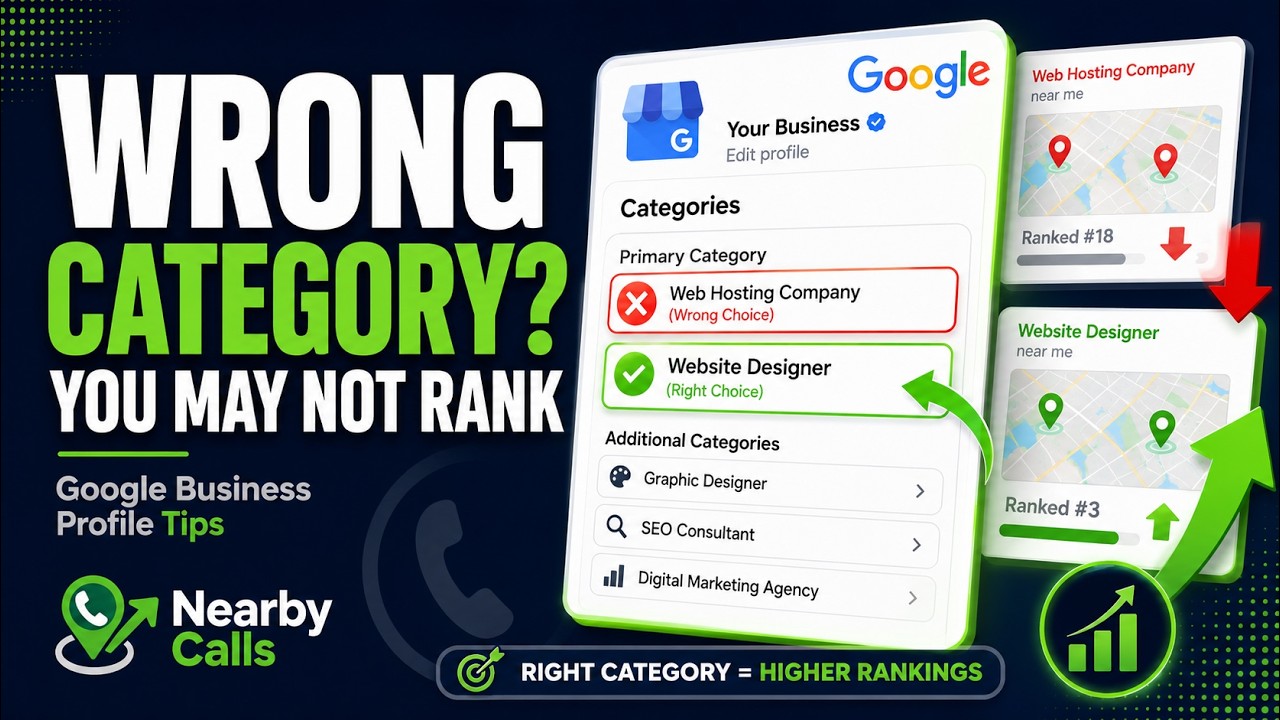
Fix Your Google Business Profile Categories to Rank Higher on Google Maps
Watch on YouTube
Review velocity and sentiment analysis over total volume
A dentist with 47 reviews who gets three new five-star ratings every week will almost always outperform a dentist with 500 reviews who hasn't received a new one in six months. This is known as review velocity. What separates businesses that generate more calls is the realization that Google prioritizes 'freshness' and consistent customer engagement. A stale profile suggests a business might be closed or declining in quality, leading Google to park you further down the search results.
High-call businesses also focus on the content within the reviews, not just the star rating. When a customer writes, 'The technician arrived on time and fixed my leaky pipe in Scottsdale,' they are giving Google literal keywords and location data. The algorithm reads these reviews to understand what services you actually perform and where you perform them. You should encourage customers to mention the specific service they received and their neighborhood to build this organic relevance.
Replying to reviews is another missed opportunity for many. The top performers reply to 100% of their reviews, both good and bad, within 24 to 48 hours. This signals to Google that you are an active, responsive business. More importantly, when a prospective caller sees that you address complaints professionally and thank regulars by name, they feel much more comfortable clicking the 'Call' button.
Don't fall into the trap of thinking a 4.9 rating is better than a 4.7. Data shows that consumers often trust a 4.7 or 4.8 more because it looks authentic. A perfect 5.0 with zero negative feedback can sometimes trigger skepticism. The separator here is authenticity; show that you are a real business dealing with real people every day. Related reading: Why Some Businesses Get More Calls Than Others.
Behavioral signals from high intent photo updates
Most owners upload five photos when they create their profile and never touch it again. The businesses generating the most calls treat their photo gallery like a live social media feed. They upload team photos, completed project shots, and even photos of their branded trucks. This isn't just for the customers; Google's Vision AI analyzes these images to verify that you are a legitimate local entity and that your photos match your listed services.
Consider a roofing contractor. If they regularly upload high-resolution photos of shingle repairs and new roof installations, Google understands they are an active roofer. When someone searches for 'roofing repair,' Google is more likely to show the profile with 50 recent photos of roofs than a competitor with one professional headshot and a picture of their office building. Visual proof of work is one of the strongest conversion triggers for phone calls.
You should also look at the 'Customer Photos' section. Encouraging your clients to upload their own photos of the finished result adds a layer of social proof that your own professional photos cannot match. User-generated content is viewed as more trustworthy by both Google and potential customers. A photo of a happy homeowner standing next to their new water heater is worth dozens of stock images.
Labels and descriptions on your photos also matter. When you upload a photo, ensure the file name reflects the service, like 'kitchen-remodeling-los-angeles.jpg,' rather than a generic string of numbers. While Google is getting better at seeing what is in a photo, giving the algorithm clear text signals helps ensure your images appear in the 'Photos' tab of relevant search queries. Related reading: How to Turn More Google Views Into Calls.
Local SEO trends in proximity and service area management
Proximity is the single largest ranking factor, but it is not the only one. What separates businesses that generate more calls is how they manage their Service Area Business (SAB) settings. If you are a mobile locksmith, you don't have a physical storefront for customers to visit, but you still need to define your territory. Winners in this space don't just select a 50-mile radius; they specifically list the cities and zip codes where they actually want to work.
Google is increasingly cracking down on businesses that claim massive service areas they cannot realistically cover. If your office is in downtown Chicago but you claim to service all of Illinois, Google will likely dampen your visibility because the data doesn't make sense. The most successful businesses focus their efforts on a manageable radius where they can genuinely respond to calls quickly and build local denseness.
Use your website to reinforce your local footprint. If you have a page for each major suburb you serve, and you link those pages back to your Google Business Profile, you create a web of local relevance. This 'Local SEO' strategy ensures that when someone in a specific suburb searches for your service, Google sees you as the most relevant local option even if your main office is ten miles away.
Accuracy in your Name, Address, and Phone Number (NAP) across the entire internet is still vital. If your phone number on Yelp is different from your number on Google, it creates friction in Google's trust model. The businesses that get the most calls have a 'clean' data footprint, meaning every directory on the web agrees on who they are and how to reach them. Related reading: Review Patterns of Top Ranking Businesses.
Strategic use of Google Business Profile posts for conversions
Google Posts are often ignored, but they are essentially free ad space on the search results page. A business that generates more calls uses these posts to highlight specific offers, seasonal tips, or recent successes. For example, a carpet cleaner might post a 'Before and After' photo with a 'Call Now' button. This creates a direct path for the customer to move from curiosity to an actual phone conversation.
These posts expire or become less visible after a period, so high-performing businesses post at least once a week. This constant activity tells Google the business is operational and engaged with the market. It also keeps your profile looking 'full.' When a user scrolls down on your mobile profile and sees a list of recent offers and updates, it gives them more reasons to choose you over a static profile.
Real photos of your actual work, team, storefront, and completed jobs are always the top priority — they build trust in a way stock imagery simply can't match. That said, keeping a steady stream of fresh photos on your profile matters more than holding out for perfect ones. If a stock image is what you have, use it: geotag it to your service area, give it a descriptive filename, size it correctly, and get it uploaded. A consistently active gallery is its own ranking signal, so fill the gaps with stock when you must, but keep replacing them with real photos of your business as you capture them.
Include keywords naturally in your post descriptions. While Google hasn't explicitly said that post text helps you rank, there is evidence that it helps your profile show up for 'justifications.' These are the little snippets in the search results that say 'Their website mentions...' or 'A recent post says...' Providing this context to Google can be the difference between appearing in the top three or the top ten.
Analyzing Google Maps performance data to refine strategy
The businesses that consistently win don't guess; they look at their Performance tab. Google provides detailed data on how people found you, what keywords they used, and how many people clicked the 'Call' button. If you see that most of your calls are coming from people searching for 'emergency water damage,' but your profile is focused on 'general home cleaning,' you have a huge opportunity to pivot your content.
Pay close attention to the time of day and day of the week your calls are peaking. If you get a spike of calls on Saturday mornings but your profile says you are closed, you are literally throwing away money. High-call businesses adjust their hours or their answering services to match when their customers are actually trying to reach them. You can't generate calls if your profile tells the customer you aren't there to answer.
Monitor the 'Searches used to find your business' section. This is a goldmine for content ideas. If customers are finding you through a specific niche service you didn't think was important, create a dedicated post about it or add it to your services list. This data-driven approach ensures your profile is always aligned with actual market demand rather than your own assumptions.
Finally, compare your 'Directions' requests to your 'Call' clicks. If people are asking for directions but not calling, they might be visiting your store directly. If you have high call volume but low direction requests, you are likely a service-based business where your phone greeting is your first impression. Use this data to train your staff on how to handle the specific types of inquiries coming from Google. If you would rather have this handled for you, Nearby Calls keeps local profiles active, reviewed, and ranking — so the calls come in.
Frequently Asked Questions
Get found, trusted, and called on Google.
Nearby Calls helps local businesses stay active on Google, collect more reviews, and generate more customer calls.
Learn About Nearby Calls