Hidden Signals That Influence Rankings
Most business owners focus on reviews and keywords while missing the quiet metadata that actually moves the needle in Google Maps. You will learn the hidden signals that influence rankings by looking at behavioral data, photo engagement, and technical consistency. Understanding these factors will bridge the gap between appearing in search and actually getting phone calls from local customers.
On This Page
User behavioral signals and dwell time
Google tracks how users interact with your profile once they click it. If a customer searches for a plumber in Phoenix, clicks your profile, and stays there for 90 seconds reading your service descriptions, Google interprets this as a high-value match. This 'dwell time' is a hidden signal that suggests your business provides exactly what the searcher needs. If users frequently click away in two seconds, your ranking will eventually drop despite your review count.
You can increase this engagement by adding detailed service menus and frequently asked questions directly to your profile. Consider a dentist with 47 reviews who struggles to outrank a competitor with only 20 reviews. If the dentist with 20 reviews has detailed service menus and price lists, users will likely spend more time on their profile. Google sees this engagement as a vote of confidence in the relevance of that business.
The most critical behavioral signal is the click-to-call rate. When a user finds your Google Business Profile and taps the call button, it sends a powerful local ranking signal. It tells Google that your profile is not just informative but is successfully satisfying the user's intent to hire someone. Consistently generating these calls reinforces your position at the top of the Map Pack.
To maximize these signals, you must ensure your profile is sticky. Use the 'Products' or 'Services' tabs to list every specific task you perform. For example, rather than just listing 'HVAC,' list 'Emergency AC Repair,' 'Duct Cleaning,' and 'Thermostat Installation.' This keeps users clicking and reading, which feeds positive data back to the local search algorithm. Want the full picture? Read our Ultimate Guide to Google Business Profiles.
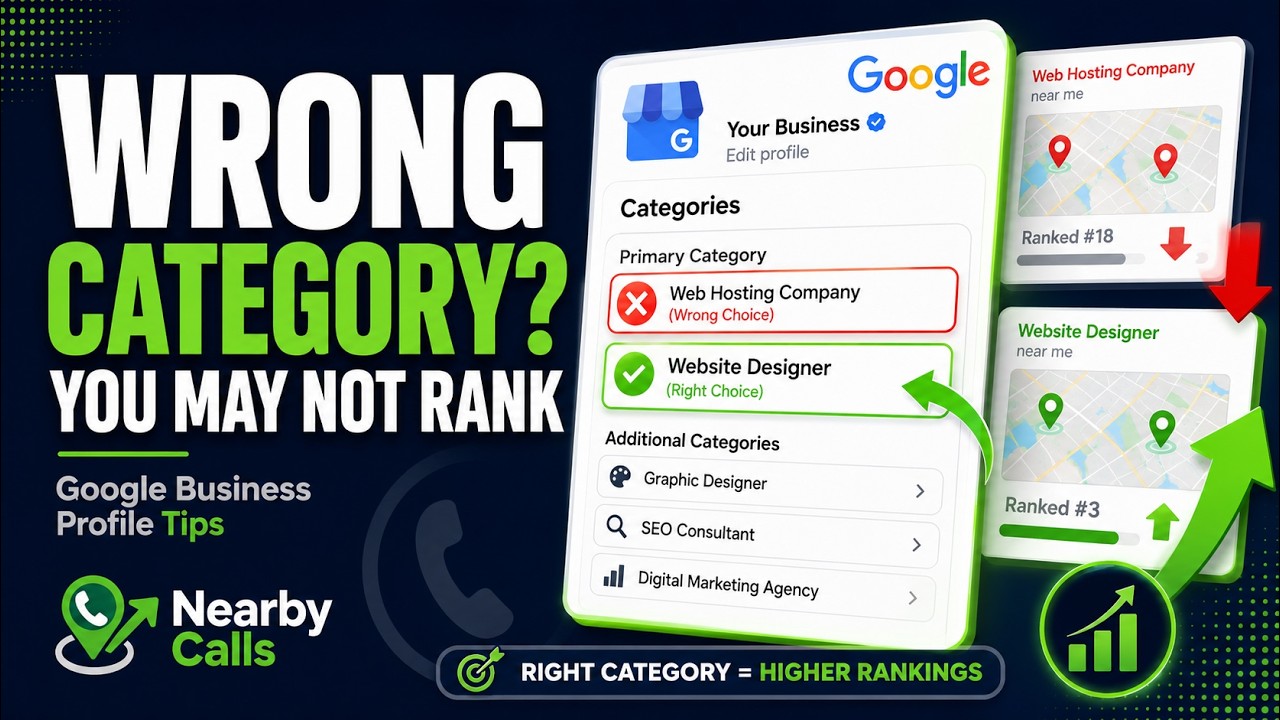
Fix Your Google Business Profile Categories to Rank Higher on Google Maps
Watch on YouTube
Photo metadata and visual relevance
Real photos of your actual work, team, storefront, and completed jobs are always the top priority — they build trust in a way stock imagery simply can't match. That said, keeping a steady stream of fresh photos on your profile matters more than holding out for perfect ones. If a stock image is what you have, use it: geotag it to your service area, give it a descriptive filename, size it correctly, and get it uploaded. A consistently active gallery is its own ranking signal, so fill the gaps with stock when you must, but keep replacing them with real photos of your business as you capture them.
The frequency of user-uploaded photos is equally important. When a customer at a local bakery uploads a photo of their sourdough bread, it carries more weight than the owner's professional shots. It proves to Google that people are physically visiting your location and interacting with your products. This real-world proof is a primary driver for local business visibility in competitive markets.
Geotagging is often misunderstood but remains a factor in how Google associates your business with specific micro-neighborhoods. While Google automatically strips most public EXIF data, they still use the upload location and the visual landmarks in the photo to confirm your service area. A landscaping company that regularly uploads photos from specific high-end zip codes is more likely to rank for searches originating in those exact areas.
Aim for a high volume of 'action shots' rather than just static office photos. Show the plumber in Phoenix actually soldering a pipe or the dentist showing a patient a digital X-ray. These images provide context that text cannot. They lower the barrier for a customer to hit the call button because they see the human element of your work, which simultaneously boosts your engagement metrics. Related reading: Understanding Google's Local Ranking Factors.
Review velocity and sentiment diversity
Total review count is a vanity metric; review velocity is the hidden signal that matters more. Velocity is the speed and consistency at which you acquire new reviews. If you get 50 reviews in one week and then zero for three months, Google sees this as artificial or a sign of a dying business. A steady stream of two or three reviews per week is much more powerful for long-term Google Maps ranking than a sudden burst.
Sentiment diversity involves the specific keywords customers use in their reviews. Google scans these for 'signal words' related to your services. If five customers mention 'fast emergency leak repair' in their reviews, your profile becomes highly optimized for that specific search query. You cannot control what customers write, but you can influence it by asking them to mention the specific service they received.
Negative reviews that you respond to professionally can actually help your ranking more than a perfect 5.0 score with no responses. Google values active management. A business owner who responds to every review—good or bad—within 24 hours shows the algorithm that the business is operational and cares about customer experience. This active status is a subtle but consistent ranking signal.
The 'Google profile calls' you receive are often a direct result of the trust built through recent reviews. Most customers will filter search results by 'Top Rated' or 'Most Recent.' If your latest review is from 2022, you are invisible to those users. High velocity ensures you remain in the consideration set for both the algorithm and the human searcher. Related reading: Why Inactive Profiles Lose Visibility.
Unstructured citations and brand mentions
Google looks beyond your own profile to see what the rest of the web says about you. Traditional citations like Yelp and Yellow Pages are the baseline, but 'unstructured' citations are the hidden gems. These include mentions in local news articles, neighborhood blogs, or community event pages. If a local newspaper mentions your hardware store's charity event, Google connects that digital mention to your physical location.
The consistency of your Name, Address, and Phone Number (NAP) across these mentions is non-negotiable. Even small discrepancies, like 'Street' versus 'St' or a different tracking number, can confuse the algorithm. While Google is getting better at merging this data, perfection in your NAP data reduces 'friction' in the ranking process and ensures your authority is credited to a single, verified entity.
Social media signals also play a role, though not as direct ranking factors. When people share links to your Google Business Profile or discuss your business on local Facebook groups, it generates branded search traffic. When Google sees an increase in people searching for your business by name, it increases your overall authority, making you appear higher for generic searches like 'dentist near me.'
Think of every local digital mention as a digital breadcrumb leading back to your profile. Whether it is a sponsorship of a Little League team or a guest post on a local real estate site, these connections build a web of local relevance. The more Google sees your business mentioned in the context of your city, the more confident it feels placing you in the top three results of the Map Pack. Related reading: Hidden Signals We Notice Across Successful Profiles.
The impact of proximity and searcher intent
Proximity is the single strongest signal in Google Maps, but it is not entirely static. While you cannot move your building, you can influence how far your 'ranking bubble' extends. A profile with high engagement and deep information can often outrank a closer competitor who has a neglected profile. This is how you win customers from the next town over even if you aren't the closest option.
Google identifies the intent behind a search to decide how much weight to give to proximity. For 'emergency' searches, like a locksmith or a burst pipe, the searcher's physical location is the priority. For 'best' searches, like 'best Italian restaurant,' Google expands the search radius and prioritizes authority and review sentiment over raw distance. Knowing which category your business falls into helps you set realistic ranking expectations.
The physical location from which you manage your profile also matters. Regularly updating your profile and responding to reviews while at your business location provides a subtle GPS signal to Google that the listing is managed by a real person at a real place. This reduces the risk of being flagged as a 'ghost' or 'lead-gen' spam listing, which is a common problem in the home services industry.
Use your Google Business Profile posts to mention specific landmarks or neighborhoods you serve. Mentioning that you just finished a job near the local stadium or the city park helps the algorithm associate your service with those specific geographic nodes. This expands your local business visibility beyond just the street where your office is located.
Technical profile completeness and attributes
Hidden deep within the Google Business Profile dashboard are 'Attributes' that many owners ignore. These include technical details like 'Wi-Fi available,' 'Wheelchair accessible,' or 'Black-owned business.' These are not just labels; they are data points that allow you to show up in filtered searches. If a customer filters for 'Veteran-led' businesses, and you haven't checked that box, you are invisible to them regardless of your SEO.
Attribute signals change seasonally. During the summer, an HVAC company might see attributes for 'Emergency Service' become more prominent. During the holidays, 'On-site services' might take priority. Checking your attributes once a month ensures you are signaling to Google that you offer exactly what current market trends demand.
The description field is often treated as a place for sales copy, but it is actually a haven for hidden signals. While keywords in the description don't carry the same weight as they did years ago, they help Google characterize your business. Use this space to clearly define your primary service and your service area without keyword stuffing. Aim for natural, descriptive language that reinforces your primary category.
Finally, ensure your website's local landing page is perfectly synced with your profile. The page you link to from your GBP should have the same phone number, the same address, and deep content about the services listed on your profile. This 'landing page relevance' is a hidden signal that confirms your profile is not a standalone entity but part of a legitimate, cohesive digital presence. If you would rather have this handled for you, Nearby Calls keeps local profiles active, reviewed, and ranking — so the calls come in.
Frequently Asked Questions
Get found, trusted, and called on Google.
Nearby Calls helps local businesses stay active on Google, collect more reviews, and generate more customer calls.
Learn About Nearby Calls