Understanding Google's Local Ranking Factors
When your phone stops ringing, it usually means your business has slipped off the first page of Google Maps. Understanding google's local ranking factors is the only way to reverse that trend and get your profile back in front of local customers. You will learn the specific signals Google uses to decide which three businesses appear in the local pack and how to optimize for them.
On This Page
The three pillars of local search ranking
Google uses three core criteria to determine your rank: relevance, distance, and prominence. Relevance measures how well your business profile matches what a person is searching for. If a homeowner in Phoenix searches for a '24-hour emergency plumber,' Google looks for profiles that specifically mention emergency services and show high activity in that category. If your profile is vague, Google will pass you over for a competitor who explicitly lists every service they provide.
Distance is the most difficult factor to control because it depends on where the user is standing when they search. A dentist in downtown Dallas will naturally rank higher for people in the city center than for people ten miles out in the suburbs. However, you can maximize your reach by clearly defining your service areas within your Google Business Profile. While you cannot move your physical office, you can influence how Google views your service radius by being active in those specific neighborhoods.
Prominence is how well-known your business is in the physical and digital world. This is based on information Google has about a business from across the web, like links, articles, and directories. For example, a restaurant that has been featured in local news and has hundreds of high-quality backlinks will often outrank a newer spot, even if the new spot is closer to the user. Improving prominence requires a consistent effort to build your brand’s reputation beyond just your profile dashboard.
When these three factors align, your Google Profile calls will increase. Google wants to provide the best possible answer to a user's query. If you prove that you are relevant, conveniently located, and highly trusted, Google will reward you with the top spot. This isn't about gaming a system, but about providing the data Google needs to feel confident recommending you to a caller who needs an immediate solution. Want the full picture? Read our Ultimate Guide to Google Business Profiles.
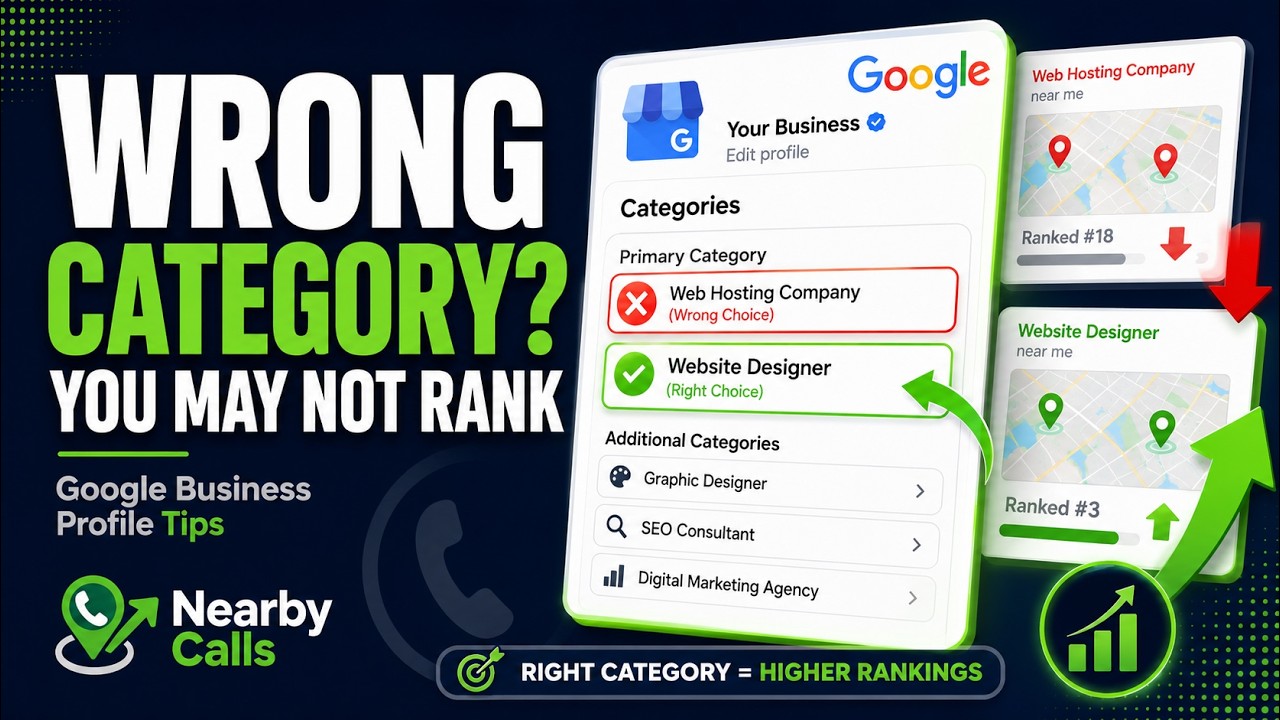
Fix Your Google Business Profile Categories to Rank Higher on Google Maps
Watch on YouTube
Google Business Profile optimization as a primary signal
Your Google Business Profile is the primary source of truth for local search. If your profile is incomplete, you are intentionally leaving money on the table. A local plumber who adds high-resolution photos of their truck, their team, and completed jobs provides visual proof of their legitimacy. This isn't just for the customer; Google’s AI scans these images to identify objects and verify that you are a real service provider in the area you claim.
Accuracy in your business name, address, and phone number (NAP) is non-negotiable. If your phone number on your website ends in 5555 but your Google profile ends in 5556, Google’s confidence in your data drops. This lack of trust results in lower rankings. Ensure every piece of information is identical across your profile, your website footer, and every social media account you own. Consistency signals to Google that your business is stable and reliable.
The 'Services' and 'Products' sections of your profile are often neglected but are vital for relevance. If you are a landscaping company, do not just select 'Landscaper' as your category. Add specific services like 'sod installation,' 'irrigation repair,' and 'hardscaping.' When a user searches for these specific terms, your profile will be triggered because you provided the specific keyword data. This level of detail is what separates the top three results from the businesses buried on page five.
Regularly publishing 'Updates' or posts on your profile also keeps your listing fresh. These posts stay active for users to see, but they also signal to Google that your business is currently operational and engaging with the community. A dentist with 47 reviews who posts a weekly oral health tip or a monthly special will often outrank a competitor who hasn't touched their profile in six months. Activity is a sign of life that Google's algorithm favors. Related reading: How Google Decides Which Businesses Rank First.
Review signals and their impact on conversion
Reviews are a heavy-hitting ranking factor because they provide social proof and keyword-rich content. When a customer writes, 'The best HVAC technician in Scottsdale fixed my AC unit on a Sunday,' they are feeding Google's algorithm exactly what it wants to see. These keywords within reviews help your profile show up for long-tail searches that you might not have targeted yourself. Encouraging happy customers to be specific about what service they received is a secret weapon for local SEO.
Velocity and recency are just as important as your total star rating. A business with 500 reviews that hasn't received a new one in a year will eventually be overtaken by a competitor who gets three new reviews every week. Google prioritizes businesses that are currently popular and consistently delivering good experiences. If your review section looks like a ghost town, potential callers will assume your business is either closed or declining in quality.
Responding to every review, whether positive or negative, shows Google that you are an active manager. Your responses should be professional and include local identifiers where natural. For example, instead of just saying 'Thanks for the review,' try 'Thanks for choosing our team for your roof repair in Austin, we glad we could help.' This subtly reinforces your location and service type to the ranking algorithm without looking like spam.
Do not fear the occasional three-star review. A profile with a perfect 5.0 rating and 200 reviews often looks suspicious to both Google and savvy customers. A realistic rating of 4.8 or 4.9 with honest feedback suggests authenticity. The key is to address any complaints publicly and solve the problem. High review engagement directly correlates to more Google profile calls because it builds the trust necessary for a user to hit the 'Call' button. Related reading: Understanding Proximity.
On-page search signals and website connection
Google looks at your linked website to verify the information on your Google Business Profile. If your website is slow, not mobile-friendly, or lacks local keywords, your Maps ranking will suffer. Every local business should have a dedicated contact page with the exact same NAP data found on their Google profile. Integrating a Google Map embed on this page further strengthens the connection between your site and your physical location.
Creating city-specific landing pages is a powerful strategy if you serve multiple areas. A carpet cleaner based in Miami who also serves Fort Lauderdale should have a dedicated page for 'Carpet Cleaning Fort Lauderdale.' This page should include local landmarks, neighborhood names, and customer testimonials from that specific area. This provides Google with the geographic context needed to rank you in searches happening outside your immediate zip code.
Content on your site should answer the questions your customers are asking. Use your blog to cover local topics, like 'How to prepare your pipes for a Chicago winter.' This type of content builds local relevance and signals to Google that you are an authority in your specific region. When Google's crawler sees your site consistently talking about local issues, it boosts your prominence in the local search ecosystem.
Technical SEO basics still apply to local ranking. Your meta titles and descriptions should include your primary service and city. For example, 'Emergency Electrician in Denver | Available 24/7' is much more effective than just 'Home Page - ABC Electric.' These small optimizations help Google's algorithm quickly categorize your business, making it more likely to show your profile to users who are ready to make a call. Related reading: Understanding Relevance.
Behavioral signals and user engagement
Google monitors how users interact with your listing to determine its value. If a user clicks on your profile and then immediately clicks the 'Call' button or 'Get Directions,' Google views this as a successful result. High click-through rates (CTR) signal that your profile is highly relevant to the search query. This creates a positive feedback loop: the more people engage with your profile, the higher Google will rank you in the future.
Dwell time on your profile also matters. If you have a large gallery of photos and a detailed 'About' section, users will spend more time looking at your listing. This level of engagement tells Google that your profile is providing the information people need. To maximize this, upload high-quality videos of your work or a virtual tour of your office. The longer you can keep a user's attention, the better your ranking signals will be.
Direct searches for your business name are another strong signal. When people search for your business by name rather than a general category, it proves you have brand prominence. This happens when you invest in offline marketing, word-of-mouth, or social media. Google notices when a business has a 'fan base' and will reward that business with better rankings for general category searches like 'bakery near me' or 'auto shop.'
The frequency of phone calls generated through the 'Call' button is a direct metric Google tracks. If your profile is driving a lot of calls, Google realizes you are a helpful result for that specific search term. This is why local business visibility is so critical; it's not just about being seen, but about driving the actions that prove to Google you are the best local option. Every phone call you receive is a vote of confidence in the eyes of the algorithm.
Citations and the importance of data consistency
Citations are mentions of your business on other websites, such as Yelp, Yellow Pages, or your local Chamber of Commerce. While they aren't as powerful as they used to be, they still serve as a foundational layer of local SEO. They act as a verification system for Google. If twenty different reputable sites all agree on your business name and address, Google's algorithm can be certain that your business is exactly where you say it is.
The real danger lies in inconsistent or 'messy' citations. If an old listing on an obscure directory still has your previous business address from three years ago, it creates a conflict in Google's data. This confusion can suppress your rankings because Google doesn't want to risk sending a customer to the wrong location. A clean-up of old, inaccurate listings is often the fastest way to see a jump in your Google Maps ranking.
Focus on quality over quantity with citations. Getting listed in a prominent local industry directory, like a 'Best Lawyers in Philadelphia' list, carries more weight than being listed on a generic global directory. These high-authority links improve your prominence and help build a web of local relevance that makes your Google Business Profile much more competitive. It's about being seen in the right places by the right people.
Don't forget the importance of 'unstructured' citations. These are mentions of your business in local news articles, blog posts, or even neighborhood forum discussions. These organic mentions are difficult to fake and highly valued by Google. They prove that your business is a real part of the local community. By engaging with your local community and getting mentioned in local media, you strengthen the overall prominence signal for your Google ranking. If you would rather have this handled for you, Nearby Calls keeps local profiles active, reviewed, and ranking — so the calls come in.
Frequently Asked Questions
Get found, trusted, and called on Google.
Nearby Calls helps local businesses stay active on Google, collect more reviews, and generate more customer calls.
Learn About Nearby Calls