Google decides which businesses to show based on how well a profile matches what a person is searching for. Understanding relevance is the first step to ensuring your business appears when a local customer needs your specific service or product. In this guide, you will learn how to align your Google Business Profile with search intent to drive more phone calls and store visits.
On This Page
The mechanics of relevance in local search
Relevance is the foundational pillar of the local search algorithm. While distance and prominence matter, relevance acts as the gatekeeper. If Google does not believe your business provides exactly what the user is looking for, you will not appear in the Local Pack, even if you are the closest option. For example, if a homeowner in Phoenix searches for 'emergency water heater repair,' Google scans local profiles for those specific terms. A plumber who simply lists 'plumbing services' may lose out to a competitor who explicitly mentions 'water heater repair' and 'emergency service' across their profile and website.
Google builds a digital map of your business's identity by crawling your Google Business Profile, your website content, and third-party mentions. This process is about matching keywords to intent. When a user types a query, Google asks, 'Does this business offer this specific thing?' Your job is to provide as much factual data as possible to make that answer a definitive 'yes.' If your data is vague, Google will default to a competitor who provides more clarity. This clarity is what ultimately triggers the 'Call' button on your profile.
You should view relevance as a bridge between a problem and a solution. When a user is in a hurry, they use specific language. A parent looking for a 'pediatric dentist who takes PPO insurance' has a very different intent than someone looking for 'cosmetic teeth whitening.' To rank for the former, your profile must contain those specific signals. Understanding relevance means moving away from generic marketing speak and focusing on the granular details of your actual daily operations.
Every piece of information you add to your digital presence contributes to your relevance score. This includes your primary and secondary categories, your service menu, and even the words your customers use in their reviews. A dentist with 47 reviews that all mention 'painless root canal' will have much higher relevance for root canal searches than a dentist with 100 reviews that only say 'great staff.' Specificity wins in local SEO because it builds trust with the algorithm. Want the full picture? Read our Ultimate Guide to Local SEO.
Strategic selection of business categories
Your primary category is the single most important relevance signal on your Google Business Profile. You must choose the category that most closely describes your core business. If you are a landscaping company that mostly does irrigation, setting your primary category to 'Irrigation equipment supplier' instead of 'Landscaper' drastically changes who sees your profile. A common mistake is choosing a category that is too broad or too narrow, which can cause you to miss out on high-intent search traffic.
Secondary categories allow you to fill in the gaps and capture related searches. A full-service auto shop should use 'Auto repair shop' as the primary, but add 'Brake shop,' 'Oil change service,' and 'Tire shop' as secondary categories. This tells Google you are relevant for a wide variety of specific problems. However, do not overstuff these. Adding irrelevant categories in hopes of 'casting a wider net' actually dilutes your relevance and can confuse the algorithm, leading to lower rankings across the board.
Google frequently updates its list of available categories. It is a good practice to audit your selections every quarter. For example, if you run a boutique hotel that recently added a high-end spa, adding 'Day spa' as a secondary category can start generating phone calls from locals who aren't even looking for a room. This expansion of relevance directly impacts your bottom line by opening up new revenue streams from search terms you previously didn't rank for.
Think about your categories from the perspective of a frustrated customer. If their sink is leaking, they aren't searching for a 'Home Improvement Specialist.' They are searching for a 'Plumber.' By aligning your categories with these common-sense terms, you make it easy for Google to put your business in front of the right person at the right time. This alignment is the core of understanding relevance in a competitive local market. Related reading: How Google Maps Rankings Work.
Warning: Edit sensitive fields carefully.Changing your primary category, business name, address, or phone number can push your profile back into an unverified state and temporarily unpublish it from Google Search and Maps until you re-verify (often by video). Make category refinements deliberately, one change at a time, and avoid editing multiple sensitive fields in the same week.
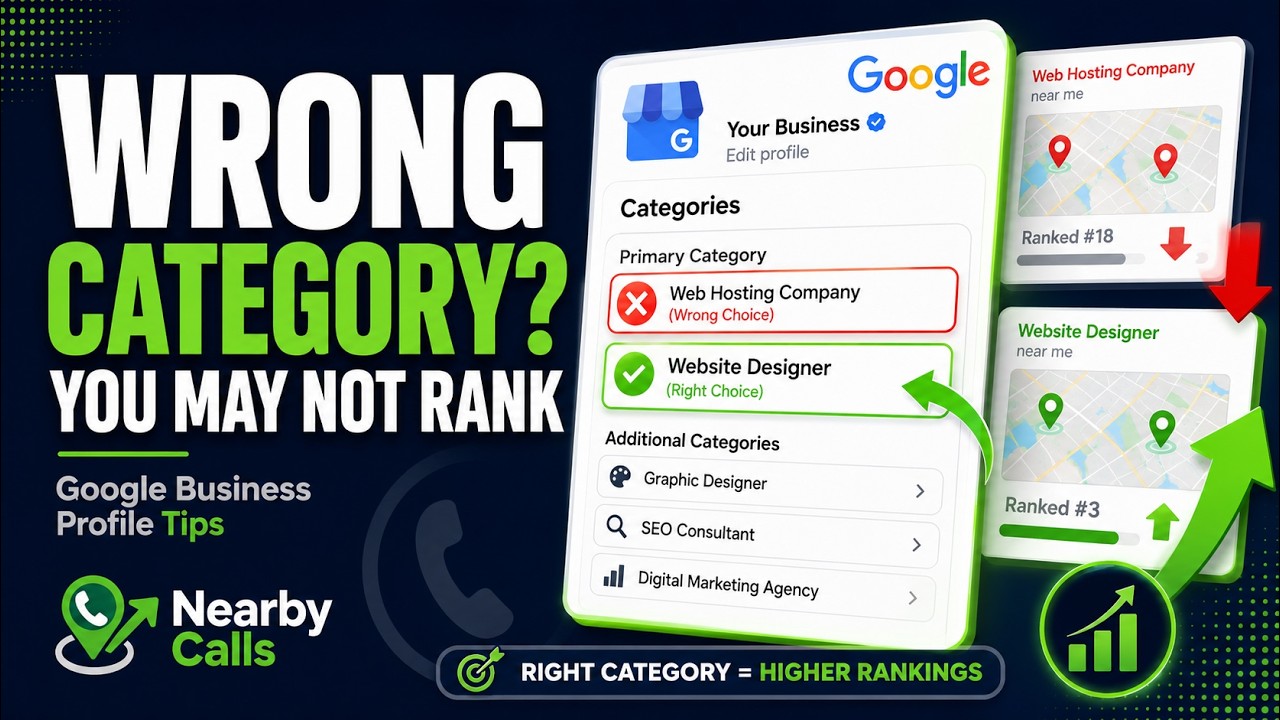
Fix Your Google Business Profile Categories to Rank Higher on Google Maps
Watch on YouTube
Optimizing service menus and product catalogs
The services section of your Google Business Profile is a direct communication line to the search engine. Many owners leave this blank or use the automated suggestions, but this is a mistake. Each service you list should have a unique description that includes local keywords and specific details. A personal injury lawyer in Chicago should not just list 'Legal Services.' They should list 'Car Accident Consultation,' 'Medical Malpractice Representation' and 'Workplace Injury Claims.'
When you add these specific services, Google can match your profile to 'long-tail' searches. These are longer, more specific phrases that often have higher conversion rates. A person searching for 'hardwood floor refinishing near me' is much closer to making a purchase than someone searching for 'flooring.' By having a detailed service menu, you're telling Google exactly which 'long-tail' problems you can solve, which boosts your relevance for those high-value queries.
If you sell physical goods, the Product Editor is equally vital. Each product entry acts as a mini-webpage that Google can index. Including high-quality photos, pricing, and descriptions for your top-selling items creates a rich shopping experience directly on the search results page. For a local hardware store, listing specific brands of lawnmowers or power tools can help you outrank national big-box stores that may have weaker local relevance for those specific items in your neighborhood.
Regularly updating these sections also signals to Google that your business is active. An active profile is generally seen as more reliable and relevant than one that hasn't been touched in three years. If you add a new seasonal service, like 'Snow Removal' in the winter, make sure it is front and center. This real-time relevance ensures that when the weather hits, your phone is the one ringing. Related reading: Understanding Prominence.
The role of keywords in business descriptions
Your business description is a 750-character space to sell your business to both humans and the algorithm. While Google says that keywords in the description do not officially impact rankings like they used to, they significantly impact your click-through rate. A well-written description that mentions your city and your most popular services confirms to the user that they have found the right place. This user behavior—clicking on your profile and staying there—signals relevance to Google.
Avoid the temptation to 'keyword stuff' your description. Writing a list of cities and services like 'Plumber Phoenix, Plumber Scottsdale, Plumber Tempe' looks like spam and turns off potential customers. Instead, write naturally: 'Serving the Phoenix valley for over 20 years, we specialize in residential plumbing repairs, leak detection, and 24/7 emergency service.' This covers your bases while maintaining a professional tone that builds trust.
Use this space to highlight your Unique Selling Proposition (USP). If you are a bakery that offers 'gluten-free wedding cakes,' that is a major relevance signal. Someone searching for that specific item is more likely to call you if they see it mentioned in your description. Highlighting these niche specialties helps you dominate small, highly profitable segments of your local market.
Consistency is key across the web. Your description on Google should mirror the tone and facts found on your website and social media profiles. When Google sees the same information repeated across multiple authoritative sources, it gains 'confidence' in your data. This confidence leads to higher rankings because Google is certain that recommending your business will result in a positive experience for the searcher. Related reading: How Google Understands Local Businesses.
Using Google Posts to boost topical relevance
Google Posts are underutilized tools for building relevance. These are essentially social media updates that appear directly on your search profile. Every time you post about a specific project, a new product, or a limited-time offer, you are feedng Google fresh data about what your business does. A roofing contractor who posts photos of a 'recent tile roof repair in Mesa' is building relevance for both the service and the location.
These posts should be used to answer common customer questions or highlight specific expertise. If you run a gym and you post about a new 'Kettlebell for Beginners' class, Google now knows you are relevant for kettlebell-related searches. Without that post, Google might only see you as a general fitness center. These incremental gains in relevance add up, eventually allowing you to rank for hundreds of different search permutations.
The frequency of your posts also matters. A business that posts once a week appears more 'current' than a competitor who hasn't posted since 2019. In industries where things change quickly—like restaurants with rotating menus or boutiques with seasonal arrivals—frequent posting is a necessity. It ensures that your relevance is always tied to what you are currently offering, preventing frustrated calls from customers looking for something you no longer have.
Always include a call-to-action (CTA) button in your posts. Whether it is 'Book Now,' 'Call Now,' or 'Learn More,' these buttons turn your relevance into measurable actions. When Google sees that users are clicking 'Call' after reading a post about your new service, it reinforces the fact that your business is a highly relevant answer to that user's query.
Website signals and the 'Local Juice' connection
Your website is the 'brain' that supports your Google Business Profile. Google heavily leans on the content of your website to determine how relevant you are for local searches. If your profile says you are a 'HVAC Contractor' but your website only talks about 'Air Conditioning,' you might struggle to rank for 'Heating Repair.' You must ensure that every service mentioned on your profile has a dedicated, detailed page on your website.
Local landing pages are a powerful way to increase relevance for specific geographic areas. If you are a carpet cleaner based in one city but you serve five surrounding suburbs, create a page for each: 'Carpet Cleaning in [Suburb Name].' On these pages, mention local landmarks, neighborhood names, and specific services you provide there. This creates a hyper-local relevance signal that helps you show up in the Maps 'three-pack' for those outlying areas.
Don't overlook the technical side of relevance, such as Schema markup. This is a bit of code you add to your website that tells search engines exactly what your data means. You can use 'LocalBusiness' schema to define your address, phone number, and hours of operation. This clarifies your information for Google, reducing the chance of errors and ensuring your 'Call' button is connected to the right number and your 'Directions' button leads to the right front door.
In the end, relevance is about the total digital footprint. When your website, your Google profile, and your customer reviews all tell the same story about what you do and where you do it, Google will reward you. This cohesive strategy is what separates the businesses that occasionally get a call from the ones that have a steady stream of leads every single day. If you would rather have this handled for you, Nearby Calls keeps local profiles active, reviewed, and ranking — so the calls come in.
Frequently Asked Questions
Get found, trusted, and called on Google.
Nearby Calls helps local businesses stay active on Google, collect more reviews, and generate more customer calls.
Learn About Nearby Calls