
How Google Decides Which Businesses Rank First
You know that being the first name on Google Maps can be the difference between a busy schedule and a silent phone. Understanding how Google decides which businesses rank first allows you to stop guessing and start focusing on the specific metrics that drive local visibility. This guide breaks down the core ranking algorithm so you can turn your Google Business Profile into a consistent source of new customer calls.
On This Page
The three pillars of local search algorithms
Google uses a distinct algorithm for local results compared to standard web search. The three main factors are relevance, distance, and prominence. Relevance measures how well your profile matches what someone is searching for. If you are a plumber in Phoenix and a homeowner types in 'burst pipe repair,' Google scans your categories, services, and description to see if you are a fit. If your profile only mentions general 'handyman' tasks, you will lose out to a competitor who explicitly lists emergency plumbing.
Distance is the most difficult factor to control but the easiest to understand. Google prioritizes businesses physically closer to the user’s current location. If someone is standing three blocks away from your dental office, you have a massive advantage over a dentist five miles away. However, distance is not the final word. Google will frequently bypass a closer business if a slightly further one is significantly more relevant or prominent. Your goal is to maximize your reach so that Google feels confident showing your business even to people who are not standing right outside your front door.
Prominence is essentially a popularity contest based on data from across the web. This includes your review count, your star rating, and how often your business is mentioned on other reputable websites. A dentist with 47 reviews and a 4.9-star rating will almost always outrank a competitor with only 3 reviews, even if the competitor is closer to the user. Google wants to provide a safe and high-quality recommendation, so they look for social proof that you are a reliable choice. When you build prominence, you convince the algorithm that your business is the authority in your neighborhood.
These three pillars work in tandem. You cannot rely on just one to carry your ranking. A business that is relevant and prominent can overcome a distance disadvantage. Conversely, a business that is very close but has a 2-star rating will likely be hidden because Google views it as a poor user experience. Balancing these factors is the key to winning the top spot on the map pack and driving more phone calls to your staff. Want the full picture? Read our Ultimate Guide to Google Business Profiles.
Primary category selection and profile completeness
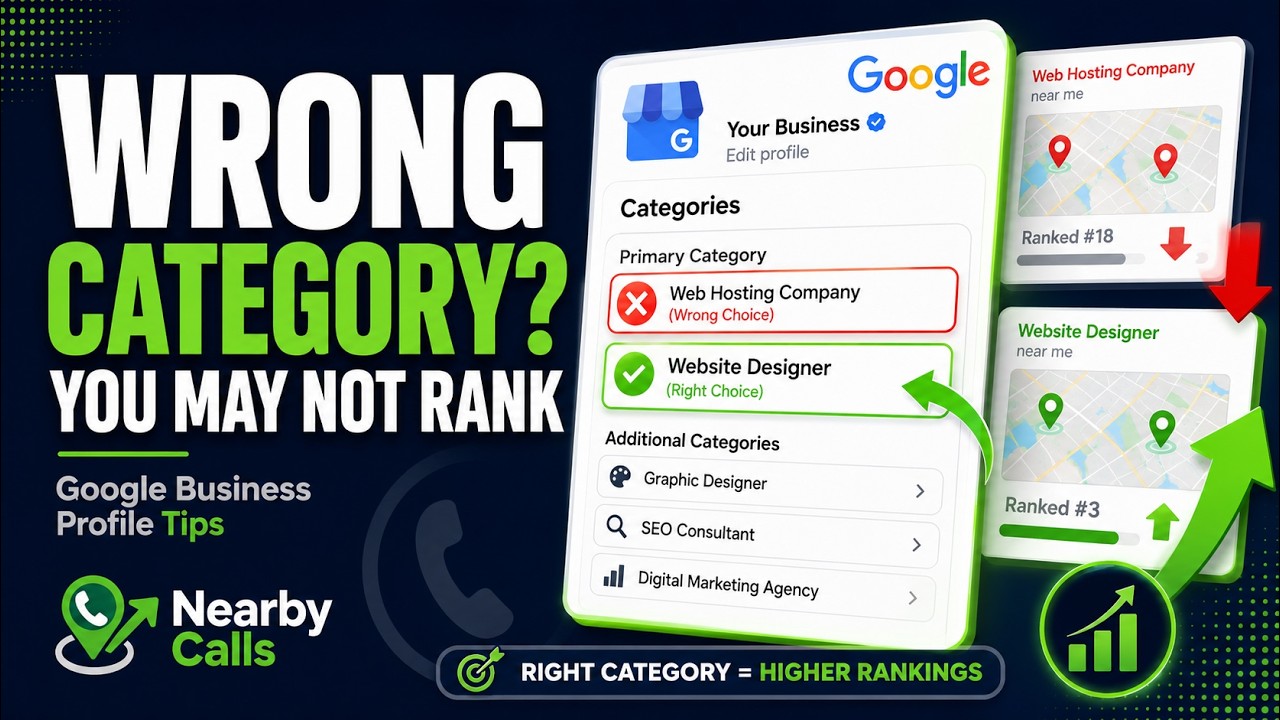
Relevance begins with your primary category. Many business owners make the mistake of choosing a category that is too broad or, worse, one that does not accurately reflect their main revenue driver. If you run a high-end landscaping company, selecting 'Landscape Gardener' is better than just 'Gardener.' Google uses this primary category as the strongest signal for what your business actually does. If this is wrong, you will show up for the wrong searches, leading to wasted clicks and zero calls.
Beyond the primary category, you must fill out every possible field in your Google Business Profile. Google rewards completeness because it provides more data points for their AI to parse. This includes your service area, business hours, and a detailed 'from the business' description. When a plumber in Phoenix includes specific neighborhood names and specific services like 'water heater installation' or 'slab leak detection,' they are feeding the algorithm the keywords it needs to match them with local searchers.
Service menus are often overlooked but are critical for ranking. Don’t just list a category; break down every individual task you perform. For a dentist, this means listing teeth whitening, root canals, and emergency consultations as individual services. When a user searches for a specific procedure, Google can look at your service menu and see a direct match. This granularity increases your relevance score and makes it more likely that Google will show your profile with a bolded 'Provides: [Service]' snippet.
The completeness of your profile also affects user trust. A profile with missing hours or no photos looks abandoned. Google’s algorithm is designed to favor active, healthy businesses. An incomplete profile is a signal to Google that your information might be out of date, which represents a risk to the user. By ensuring every field is populated with accurate, keyword-rich information, you remove friction for both the algorithm and the potential customer. Related reading: Why Your Google Business Profile Isn't Ranking.
Fix Your Google Business Profile Categories to Rank Higher on Google Maps
Watch on YouTube
Review velocity and sentiment analysis
Google does not just count your reviews; it analyzes how fast you get them and what they actually say. Review velocity refers to the consistency of new feedback. If a house painter gets 20 reviews in one week and then nothing for six months, the algorithm may view those reviews as stale or potentially manipulated. A steady stream of 2 or 3 reviews every week is much more powerful for long-term ranking than a single spike. It tells Google that you are still in business and consistently satisfying customers.
Sentiment analysis is the process where Google’s AI reads the text of your reviews to understand your strengths. If customers repeatedly use words like 'professional,' 'on time,' or 'fair price,' Google associates those attributes with your business. For example, if a user searches for an 'affordable plumber,' Google will scan reviews for that specific keyword. If your customers have mentioned your 'affordable' rates, you are far more likely to rank first for that specific search query.
The way you respond to reviews also impacts your visibility. While replying doesn't directly boost your 'score' in a mathematical sense, it encourages more people to leave reviews and shows Google that the profile is managed by an active owner. When you respond, you have another opportunity to naturally include service names. Instead of saying 'Thanks for the review,' try saying 'Thanks for letting us help with your kitchen pipe repair in Phoenix.' This reinforces your relevance for those specific terms without looking like spam.
Negative reviews are inevitable, but they don't have to ruin your ranking if you handle them correctly. Google understands that no business is perfect. A 4.8-star rating with 100 reviews is often more credible to both the algorithm and the user than a perfect 5.0 with only 5 reviews. The key is to maintain a high volume of positive feedback to drown out the occasional outlier. High prominence is built on a foundation of consistent, high-quality customer experiences that are documented publicly on your profile. Related reading: Understanding Google's Local Ranking Factors.
The impact of local citations and NAP consistency
Google looks outside of its own platform to verify that your business is legitimate. It scans the rest of the internet for your Name, Address, and Phone number (NAP). If your business is listed on Yelp, the Better Business Bureau, and local chamber of commerce sites with the exact same information, Google gains confidence in your data. If your phone number is different on your website than it is on your Google profile, it creates 'data friction,' which can suppress your rankings.
Local citations act as digital votes of confidence. Each time a reputable local site mentions your business, your prominence score increases. For a local business, getting onto a 'Top 10 Best Contractors in Phoenix' list on a local news site is worth more than a mention on a generic national blog. Google's algorithm is sophisticated enough to recognize the geographic relevance of the sites linking to you or mentioning your business.
Inconsistencies often happen during business moves or phone number changes. If you changed your office location last year but half of your online directory listings still show the old address, Google won't know which one to trust. In these cases, it will often default to not showing your business at all to avoid sending a user to the wrong location. Cleaning up these old citations is a fundamental step in proving to Google that you are a stable, reliable local entity.
You should also ensure that your NAP data matches the footer of your own website exactly. Small details like 'Street' versus 'St.' or 'Suite 100' versus '#100' should be standardized across the web. While Google is getting better at recognizing these variations, keeping them identical removes any doubt for the algorithm. This consistency builds a 'trust anchor' that helps your profile climb higher in the Google Maps results. Related reading: How Google Maps Rankings Work.
Photos and user engagement signals
Engagement signals are metrics that show Google how people interact with your profile once they find it. This includes how many people click 'Call,' how many request directions, and how many people click through your photo gallery. High engagement tells Google that your profile is a high-quality result for that search. Profiles with more photos get significantly more requests for directions and calls than those with just a handful of images.
The type of photos you upload matters. Google uses image recognition AI to see what is in your pictures. If you are a dentist, you should have photos of the office exterior, the waiting room, and the staff in action. When Google's AI identifies medical equipment or a dental chair in your photos, it further confirms your business category. This automated verification adds another layer of relevance to your profile that text alone cannot provide.
User-generated content is particularly powerful. When a customer uploads a photo of a finished bathroom remodel and ties it to a 5-star review, Google treats that as highly credible evidence of your work. Encourage your clients to take photos and post them. These 'real world' images often perform better than professional stock photography because they show the actual results people can expect. This social proof directly leads to more phone calls as potential customers see visual evidence of your quality.
Regularly posting updates to your Google Business Profile also boosts engagement. These posts can be about recent projects, special offers, or helpful tips. While posts might not be a direct ranking factor in the same way your primary category is, they keep your profile looking fresh and give users more reasons to click. Every click is a signal to Google that your business is the most 'clickable' and therefore the best option to rank first.
Website signals and local organic SEO
Your Google Business Profile does not exist in a vacuum; it is tethered to your website. Google looks at the page you link to from your profile to find more context about your business. If your website is slow, not mobile-friendly, or lacks local keywords, it will drag down your Maps ranking. Your website should have a dedicated contact page with the same NAP data found on your profile, along with an embedded Google Map showing your location.
Local content on your website reinforces your geographic authority. If a plumber in Phoenix writes blog posts about 'How to prevent pipes from freezing in Arizona' or 'Common plumbing issues in Scottsdale homes,' Google associates that website and the connected Google Business Profile with those specific locations. This strengthens your 'Distance' pillar by proving that while you are based in one spot, your expertise and service area cover a broader region.
Backlinks to your website also play a massive role in your map ranking. When other local businesses or organizations link to your site, it increases your overall prominence. A link from a local high school sports team you sponsored or a local charity event carries significant weight in local search. These links act as a 'local' authority signal that helps Google decide you are a pillar of the community, making you a safer bet to rank at the top of the search results.
Finally, ensure your website uses 'Schema Markup' for local businesses. This is a bit of code that speaks directly to search engines, clearly defining your hours, location, and services in a structured format. It makes it easier for Google to index your information accurately without having to guess. When your website and your Google Business Profile are perfectly synced and providing the same high-quality data, you create a powerful synergy that is very difficult for competitors to beat. If you would rather have this handled for you, Nearby Calls keeps local profiles active, reviewed, and ranking — so the calls come in.
Frequently Asked Questions
Get found, trusted, and called on Google.
Nearby Calls helps local businesses stay active on Google, collect more reviews, and generate more customer calls.
Learn About Nearby Calls