
Why Businesses Misunderstand Local SEO
Most business owners treat local SEO like a digital phone book entry rather than a competitive ranking system. You will learn why thinking about rankings geographically is different from traditional organic search and how to fix the common mental traps that stop your phone from ringing.
On This Page
The myth of the static search result
You probably check your own rankings by sitting at your office desk and typing your service into Google. If you see your business in the top three, you assume your strategy is working. This is the first major misunderstanding. Local SEO is tied to the physical location of the person searching. A plumber in Phoenix might rank number one when searching from their shop in Mesa, but they could be invisible to a homeowner five miles away in Scottsdale.
Google uses a proximity filter that creates a 'heat map' of visibility. If you aren't tracking your rankings across a grid of several miles, you are making decisions based on incomplete data. You need to understand that your position changes block by block. If your Google Business Profile isn't optimized for the specific neighborhoods you serve, you are losing calls to competitors who simply happen to be closer to the lead at that exact moment.
Advanced local SEO requires you to think in terms of radius coverage. You want to expand the circle of where you appear in the Map Pack. This isn't done by just keyword stuffing your profile. It involves localized content, geo-tagged signals, and building relevance for the city names and landmarks surrounding your primary office. Without this perspective, you will always wonder why your competitors are busier than you despite having a 'better' website.
Stop looking at a single ranking report. Start looking at how your visibility decays as a user moves away from your front door. The moment you realize your ranking is fluid and location-dependent, you can start building a strategy that actually captures more market share across your entire service area. Want the full picture? Read our the full guide.
Review quality over review quantity
A common mistake is chasing a specific number of reviews and then stopping. A dentist with 47 reviews might feel safe until a new clinic opens and gets 10 reviews in two weeks. Google cares about recency and velocity more than just the total count. If your last review was from six months ago, Google views your business as less active or potentially closed, which pushes you down in the search results.
The content inside the reviews matters just as much as the star rating. Business owners often misunderstand how Google parses text within a review. When a customer writes, 'The plumber fixed my leaking copper pipe in Scottsdale,' it tells Google exactly what services you provide and where you provide them. This natural language processing strengthens your relevance for those specific search terms.
You should never settle for a generic five-star rating with no text. You need to prompt your customers to describe the specific problem you solved. If you run an HVAC company, a review that mentions 'emergency AC repair' is worth ten reviews that just say 'Great job.' This is a core part of an advanced local SEO strategy that most businesses ignore because they are too focused on the 5.0 score.
Responding to reviews is the final piece of this puzzle. Many owners think responses are only for customer service, but they are also for Google. When you reply and mention the service provided, you are reinforcing your profile's authority. If you aren't responding to every single review within 24 to 48 hours, you are signaling to Google that you aren't an engaged local merchant. Related reading: Common Local SEO Myths.
The category selection bottleneck
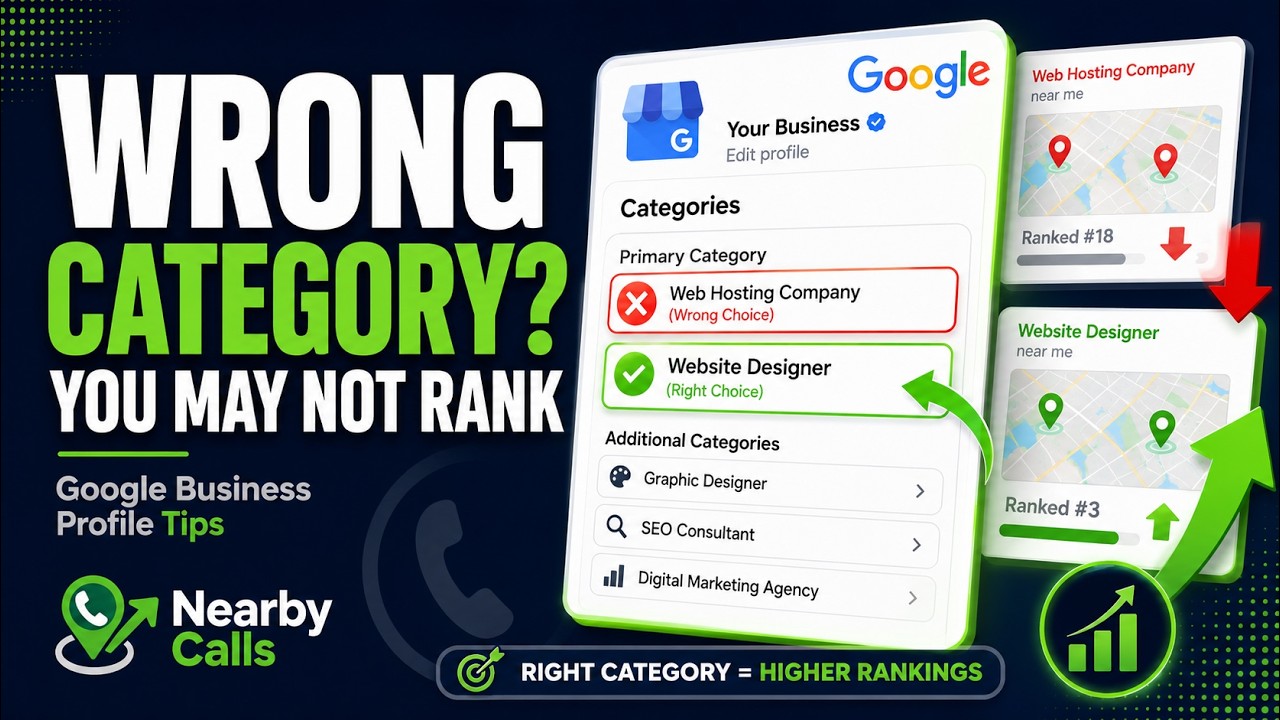
Your primary category on Google Business Profile is the single most important ranking factor you can control. Many businesses pick a generic category and never touch it again. For example, a lawyer might choose 'Attorney' when 'Personal Injury Attorney' or 'Divorce Lawyer' would be far more effective. If your primary category is too broad, you are competing against everyone; if it is too narrow, you miss out on high-volume traffic.
Secondary categories are where most businesses leave money on the table. You can select up to ten categories, but most owners only pick two or three. If you are a general contractor, you should also be listed under 'Decks', 'Kitchen Remodeling', and 'Bathroom Remodeling' if those are services you provide. Google uses these categories to decide which secondary searches you are eligible to show up for.
Misunderstanding categories often leads to 'keyword cannibalization' where your profile is confused about its main purpose. You must align your primary category with the service that drives your most profitable phone calls. If you are a roofing company that also does siding, but 80% of your revenue comes from roof replacements, 'Roofing Contractor' must stay as your primary category regardless of seasonality.
Review your categories quarterly. Google frequently updates the available options. A category that didn't exist two years ago might be the perfect fit for your business today. Staying on top of these small technical shifts is what separates a business that gets occasional clicks from one that dominates the local market and keeps its technicians busy every day. Related reading: Why SEO Takes Time.
Fix Your Google Business Profile Categories to Rank Higher on Google Maps
Watch on YouTube
Websites as local ranking signals
Business owners often think of their website and their Google Business Profile as two separate entities. In reality, they are deeply linked. Google looks at your website to find 'proof' of what your Google profile claims. If your profile says you serve 'Greater Chicago' but your website never mentions specific Chicago neighborhoods, Google will doubt your relevance and lower your ranking.
The local landing page is a tool most businesses fail to use correctly. If you serve multiple cities, you need a dedicated page for each one. A cleaning service in Dallas should have pages for Plano, Frisco, and Arlington. These pages shouldn't just be duplicates with the city name swapped out. They need local photos, local testimonials, and mentions of local landmarks to prove to Google that you actually operate in those areas.
Technical speed and mobile optimization are non-negotiable for local search. Most local searches happen on a mobile device when someone is in a hurry. If your site takes five seconds to load, the user will go back to the Map Pack and click the next business. Google tracks these 'pogosticks' and will penalize your ranking if it sees that users are consistently abandoning your site for a competitor's.
Your website's 'NAP' (Name, Address, Phone Number) must be identical to your Google profile. Even a small discrepancy, like using 'St.' on your site and 'Street' on Google, can create data fragments that weaken your local authority. Consistency across the web tells Google your business is a legitimate, trustworthy entity that is safe to recommend to its users. Related reading: The Biggest Local Marketing Mistakes We See.
The trap of set and forget
The biggest reason businesses fail at local SEO is that they treat it as a one-time setup. They hire a guy to 'optimize' their profile, pay a one-time fee, and then never look at it again. Google is a dynamic marketplace. Competitors are constantly updating their photos, posting updates, and getting new reviews. If you are standing still, you are effectively falling behind.
Google Business Profile Posts are an underutilized tool for staying relevant. Think of these like social media updates that appear directly in your search results. Regular posting—at least once a week—shows Google that your business is active. Use these posts to highlight recent projects, share seasonal tips, or promote a limited-time offer. Every post is a fresh signal to Google's algorithm that you are open for business.
Real photos of your actual work, team, storefront, and completed jobs are always the top priority — they build trust in a way stock imagery simply can't match. That said, keeping a steady stream of fresh photos on your profile matters more than holding out for perfect ones. If a stock image is what you have, use it: geotag it to your service area, give it a descriptive filename, size it correctly, and get it uploaded. A consistently active gallery is its own ranking signal, so fill the gaps with stock when you must, but keep replacing them with real photos of your business as you capture them.
Monitoring your profile for 'suggested edits' is a daily task. Competitors or even random users can suggest changes to your phone number, hours, or website link. If you aren't watching your dashboard, these changes can go live without your approval. This can lead to lost calls, wrong directions, and a massive drop in your conversion rate before you even realize anything is wrong.
Ignoring the behavior of local competitors
You aren't competing against the internet; you are competing against the five businesses within a three-mile radius of you. If you don't know what they are doing, you can't beat them. Advanced local SEO involves a deep dive into the competition. Are they getting more reviews? Do they have better photos? Are they using a specific category you missed?
Look at the 'Business Description' of the people outranking you. While the description itself isn't a direct ranking factor, it influences click-through rates. If your competitors have a clear call-to-action or mention a 24/7 service that you also offer but didn't list, they will win the customer's attention every time. You need to identify the gaps in their strategy and fill them in your own.
Spam fighting is a legitimate part of a local SEO strategy. Many businesses use fake names that include keywords, like 'Best Phoenix Plumber & Drain Cleaning' instead of their legal name. This is against Google's terms of service. By reporting these fake listings through the Redressal Form, you can clear out the 'cheaters' and naturally move up in the rankings without changing a single thing on your own profile.
Local search competition is a zero-sum game. There are only three spots in the Map Pack. To get in, you have to knock someone else out. This requires a level of aggression and attention to detail that most business owners aren't prepared for. When you treat local SEO as a tactical battle for those three spots, you start making the right moves to drive consistent phone calls and high-quality leads. If you would rather have this handled for you, Nearby Calls keeps local profiles active, reviewed, and ranking — so the calls come in.
Frequently Asked Questions
Get found, trusted, and called on Google.
Nearby Calls helps local businesses stay active on Google, collect more reviews, and generate more customer calls.
Learn About Nearby Calls