Mistakes on your Google Business Profile do more than just make you look messy; they actively push your ranking down and hand your phone calls to your competitors. You will learn the specific, high-stakes errors we see every day that cause Google to doubt your business's legitimacy. Fixing these issues turns your profile back into a lead-generation tool rather than a dormant listing.
On This Page
Keyword stuffing and business name manipulation
The most common mistake business owners make is adding extra keywords to their business name. If your legal entity is Reliable Plumbing but you change your profile name to Reliable Plumbing - Best Plumber in Phoenix 24/7 Service, you are begging for a suspension. Google's algorithm is increasingly aggressive at flagging these discrepancies against official state records and tax documents. While you might see a temporary boost in search rankings, the long-term risk of losing your entire profile and its review history is massive.
A plumber in Phoenix who uses their actual name will consistently outrank a competitor who stuffs keywords once the competitor gets reported or flagged. Modern Google Maps performance relies on trust. When your name on the screen doesn't match the name on your building or your truck, Google lowers your prominence score. This lack of consistency makes the algorithm doubt if you actually serve the area you claim, leading to fewer appearances in the local pack.
Instead of stuffing the name field, focus on your primary category. If you are a plumber, ensure that is your main selection and use your service descriptions to highlight your specific offerings like water heater repair or drain cleaning. This provides the data Google needs to match you with searchers without violating their terms of service. You get the calls by being honest and detailed in the right sections, not by cheating the title bar.
We have seen businesses lose years of reputation data overnight because of a named-based suspension. It takes weeks of back-and-forth with support to get reinstated, and you often lose revenue every hour you are offline. Keep your name clean to keep your business running smoothly. Want the full picture? Read our the full guide.
Primary category selection and dilution
Your primary category is the strongest signal you give to Google. Choosing a generic category when a specific one exists is a major missed opportunity. For example, a dentist with 47 reviews who labels themselves as a Health Consultant will never show up for someone searching for emergency tooth extraction. You must be precise; if you are a cosmetic dentist, use that specific category first, and relegate general dentistry to your secondary categories.
Secondary categories should support your main business, but adding too many irrelevant ones can actually dilute your ranking power. If you own a bakery but also start listing Wedding Venue and Party Planner because you have a small room in the back, Google gets confused about your main intent. This confusion lowers your local SEO performance because the algorithm cannot figure out which search queries are the most relevant to your core service.
Look at your local competitors who are consistently in the top three spots. Note their primary category choice. If you are a lawyer in a crowded market like Chicago, being Personal Injury Attorney is vastly more valuable than just Lawyer. This distinction dictates whether your phone rings with high-value cases or low-effort inquiries that you don't even handle.
Update your categories seasonally if your business model shifts significantly, but always keep your primary category rooted in your biggest revenue driver. Consistency in this data point helps Google build a profile of your expertise over time. When Google perceives you as an expert in one specific field, it rewards you with better placement in the Maps results. Related reading: The Most Common Google Business Profile Mistakes.
Warning: Edit sensitive fields carefully.Changing your primary category, business name, address, or phone number can push your profile back into an unverified state and temporarily unpublish it from Google Search and Maps until you re-verify (often by video). Make category refinements deliberately, one change at a time, and avoid editing multiple sensitive fields in the same week.
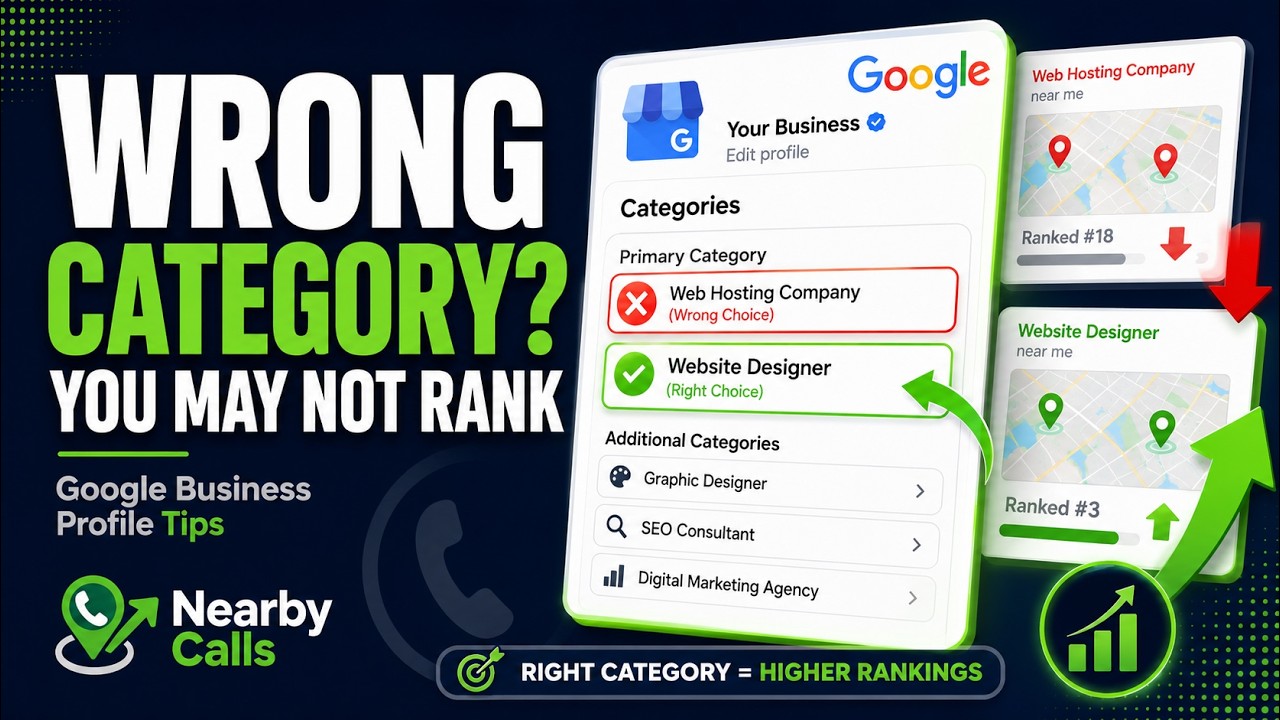
Fix Your Google Business Profile Categories to Rank Higher on Google Maps
Watch on YouTube
Ignoring the power of high-resolution visual evidence
Real photos of your actual work, team, storefront, and completed jobs are always the top priority — they build trust in a way stock imagery simply can't match. That said, keeping a steady stream of fresh photos on your profile matters more than holding out for perfect ones. If a stock image is what you have, use it: geotag it to your service area, give it a descriptive filename, size it correctly, and get it uploaded. A consistently active gallery is its own ranking signal, so fill the gaps with stock when you must, but keep replacing them with real photos of your business as you capture them.
We see a direct correlation between the frequency of photo uploads and the number of phone calls a profile generates. A landscape designer who uploads three new project photos every week signals to Google that the business is active. This activity is a ranking signal. It tells the algorithm that your business is open, busy, and providing value to the community right now. Old, outdated photos suggest a business might be closed or struggling.
Ensure you have photos of your exterior and interior. For service-area businesses like mobile mechanics, photos of your branded van parked in front of local landmarks or street signs act as geographical proof. This visual data anchors your profile to your specific city more effectively than any keyword in a description ever could. It makes Google more confident in showing your profile to people in that exact neighborhood.
Encourage your customers to upload their own photos with their reviews. User-generated content is arguably the most powerful social proof you can have. When a customer posts a photo of a meal at your restaurant, Google trusts that more than your professional photography. These organic images help build a realistic expectation for new customers, which leads to better conversion rates once they find your listing. Related reading: The Most Overlooked GBP Opportunities.
Inconsistent NAP data across the web
NAP stands for Name, Address, and Phone number. This is the foundation of local SEO. A common mistake is having 123 Main St. on your Google Profile but 123 Main Street, Suite A on your Yelp listing and your website. While this seems minor to a human, Google's algorithm is looking for perfect matches. Discrepancies make the algorithm less certain about your location, which can push you out of the top results for 'near me' searches.
If you have recently moved or changed your phone number, you must perform a full audit of every directory where your business appears. Old listings for a defunct location act as 'ghost' data that confuses search engines. If Google sees two different addresses for the same business name, it might penalize both by not showing either in the map pack. This is one of the quickest ways to see a total drop-off in phone calls after a move.
Your phone number should ideally be a local area code that matches your service area. While toll-free numbers are fine for national brands, local businesses get a ranking boost from local numbers because they reinforce your proximity to the searcher. If your Google Business Profile uses a tracking number, make sure the primary number listed is your local one, with the tracking number set as an alternative so Google can still verify your identity through your website.
Check your social media profiles as well. Facebook, Instagram, and LinkedIn should all mirror the exact formatting of your Google Business Profile. This creates a web of consistent data that proves to Google you are a legitimate, established business. The more consistent your information, the higher the trust score Google assigns to your profile, making you more likely to win the battle for the top spot.
Failure to respond to all reviews regardless of rating
Most business owners only respond to negative reviews as damage control, but ignoring positive reviews is a significant error. Responding to every review shows Google that you are an active manager. Furthermore, the words you use in your responses can help your ranking. If a customer leaves a five-star review for your HVAC company, responding with, Thanks for the review! is a wasted opportunity. A better response is, Thanks for the five-star review for our furnace repair service in Denver!
When you include your service names and city in your responses, you are feeding the algorithm more context about what you do and where you do it. This should be done naturally, not in a way that looks like spam. A dentist with 47 reviews who responds to each one by mentioning the specific treatment discussed is creating a rich data set that helps Google understand their office's specializations.
Negative reviews require even more attention. A common mistake is getting defensive or aggressive. This doesn't just look bad to the reviewer; it scares away every future customer who reads it. Your response to a one-star review isn't for the person who wrote it—it's for the 500 people who will read it later. A calm, professional invitation to resolve the issue offline shows you are a reliable business owner.
Google has explicitly stated that responding to reviews improves your local SEO. It is one of the few direct things you can do to influence your standing that is entirely within your control. If your competitors are ignoring their reviews and you are engaging with every single one, you will eventually pull ahead in the rankings because you are providing a better user experience on Google's platform. If you would rather have this handled for you, Nearby Calls keeps local profiles active, reviewed, and ranking — so the calls come in.
Frequently Asked Questions
Get found, trusted, and called on Google.
Nearby Calls helps local businesses stay active on Google, collect more reviews, and generate more customer calls.
Learn About Nearby Calls