
What We've Learned Monitoring Thousands of Profiles
Managing thousands of Google Business Profiles provides a bird's eye view of what actually moves the needle for local search ranking. Most advice online is based on guesswork, but patterns emerge when you track millions of impressions across dozens of industries. You will learn the specific factors that generate phone calls and which common tasks are a waste of your limited time.
On This Page
Proximity and the physical location anchor
The most consistent data point we have observed is the overwhelming weight Google places on physical proximity. If a plumber in Phoenix is located in a warehouse district, they will dominate the three-pack within a three-mile radius but struggle to appear for searches ten miles away in Scottsdale. We see many business owners try to skirt this by using residential addresses or P.O. boxes, but these profiles are frequently suspended or fail to rank altogether. The lesson is that your office location acts as an anchor for your most profitable leads.
When monitoring large sets of data, we found that businesses with a central downtown office often have a higher 'reach' than those on the outskirts. However, the competition in these central hubs is significantly higher, meaning you need more reviews to maintain your spot. If you find your search volume dropping off sharply just a few blocks from your door, it usually indicates that your service area settings are too broad or your local citations do not match your current dashboard data exactly.
We also discovered that moving an office even half a mile can completely reset your local ranking profile. In one case, a dentist shifted across a major highway and saw a 40% drop in calls for three months while Google re-calibrated the new neighborhood context. You should treat your physical address as your most valuable SEO asset. Do not change it unless you are prepared for a temporary dip in performance while the search engine adjusts its proximity mapping for your specific industry.
To maximize the reach you do have, ensure your Map pin is placed exactly at your entrance. We have seen instances where a pin placed at the back of a large commercial building confused the GPS routing for customers, leading to negative reviews. These small data errors impact your 'driving direction' requests, which is a hidden signal Google uses to determine how relevant and accessible your business is to the local community. Want the full picture? Read our the full guide.
Review velocity and sentiment analysis
Raw review count matters, but review velocity is the secret driver of sustained growth. A locksmith with 500 reviews gathered over five years will often be outranked by a competitor who has gained 40 reviews in the last 30 days. Our internal data shows that Google prioritizes 'freshness' because it signals that the business is currently active and reliable. If your review stream dries up for more than two weeks, we typically see a corresponding slide in Map pack rankings.
Specific keywords inside reviews are just as important as the star rating. When a customer writes, 'Best emergency AC repair in Dallas,' Google parses that text to associate your profile with those specific services. We monitored a roofing company that encouraged customers to mention the specific material used, such as 'shingle repair' or 'metal roof installation.' Within two months, their profile appeared for those specific long-tail searches far more often than competitors who only had generic 'great service' reviews.
Negative reviews do not necessarily kill your rankings, but ignoring them does. Profiles that respond to every review—good and bad—within 24 hours show a higher conversion rate from views to phone calls. From our monitoring, the response itself isn't just for the customer; it tells Google you are an engaged owner. This engagement correlates with a 15% higher likelihood of appearing in the top three results for competitive 'near me' searches.
Avoid the temptation to buy reviews or use 'review gates' that filter out negative feedback. Google’s algorithms are increasingly sophisticated at spotting unnatural review patterns, such as a sudden burst of 50 reviews on a Tuesday from accounts with no previous history. We have seen thousands of profiles get ghost-banned—where the owner can see the profile but it never appears in search—due to these manipulative tactics. Steady, organic growth is the only way to build a profile that lasts. Related reading: The Biggest GBP Mistakes We See.
High quality images and user engagement
Real photos of your actual work, team, storefront, and completed jobs are always the top priority — they build trust in a way stock imagery simply can't match. That said, keeping a steady stream of fresh photos on your profile matters more than holding out for perfect ones. If a stock image is what you have, use it: geotag it to your service area, give it a descriptive filename, size it correctly, and get it uploaded. A consistently active gallery is its own ranking signal, so fill the gaps with stock when you must, but keep replacing them with real photos of your business as you capture them.
We tracked a group of retail stores and found that those who uploaded new photos weekly saw a 12% increase in discovery searches. This suggests that Google uses photo updates as a signal that the business is operational. If your photos are three years old, the algorithm may assume your hours or services are potentially outdated, leading it to favor a more active competitor. You should aim to upload at least two real-world photos every week to keep the profile 'warm.'
Video content is an underutilized goldmine for local businesses. Short, 30-second clips of a project walkthrough or a quick tip from the owner can keep a user on your profile longer. This 'dwell time' is a metric Google tracks. The longer a potential customer looks at your photos and videos, the more likely Google is to show your profile to the next person. High engagement leads directly to higher authority in the local ecosystem.
Always include exterior shots that show your signage and parking lot. We have seen that these specific images help reduce 'bounce rates' where a user clicks your profile and immediately leaves because they aren't sure if they can find the building. Making the physical visit seem easy through clear photography is a direct way to increase the number of phone calls and walk-in traffic you receive each month. Related reading: What Separates Businesses That Generate More Calls.
Primary category selection and subcategories
The single most important technical setting on your profile is your primary category. We have seen businesses double their call volume overnight just by switching from a generic category to a specific one. For example, an 'Attorney' profile often performs worse than a 'Personal Injury Attorney' profile if that is their main focus. Your primary category should match the highest volume search term that accurately describes your most profitable service.
Secondary categories should be used to fill in the gaps, but they can also dilute your ranking power if you overdo it. We monitored an auto repair shop that added 9 subcategories, including 'used car dealer' and 'towing service.' Their ranking for 'engine repair' actually dropped because Google became confused about the core purpose of the business. You should limit your subcategories to the 3-5 most relevant services that you actually provide on a daily basis.
Seasonal adjustments can be a powerful tool if managed correctly. A landscaping company might find success switching their primary category to 'Snow Removal Contractor' in November and back to 'Landscaper' in March. Our data suggests that Google responds to these changes within 48 to 72 hours. However, you must ensure your website content reflects these changes, as the algorithm cross-references your site to verify your claims.
Be careful with categories that trigger extra verification requirements. Specifically in home services, certain categories like 'Locksmith' or 'Garage Door Repair' are high-risk for suspensions. If you choose these, you must have your documentation ready. We've learned that Google frequently audits these industries, and having a perfectly optimized profile won't help if your business paperwork doesn't match your dashboard exactly. Related reading: The Nearby Calls Framework.
Warning: Edit sensitive fields carefully.Changing your primary category, business name, address, or phone number can push your profile back into an unverified state and temporarily unpublish it from Google Search and Maps until you re-verify (often by video). Make category refinements deliberately, one change at a time, and avoid editing multiple sensitive fields in the same week.
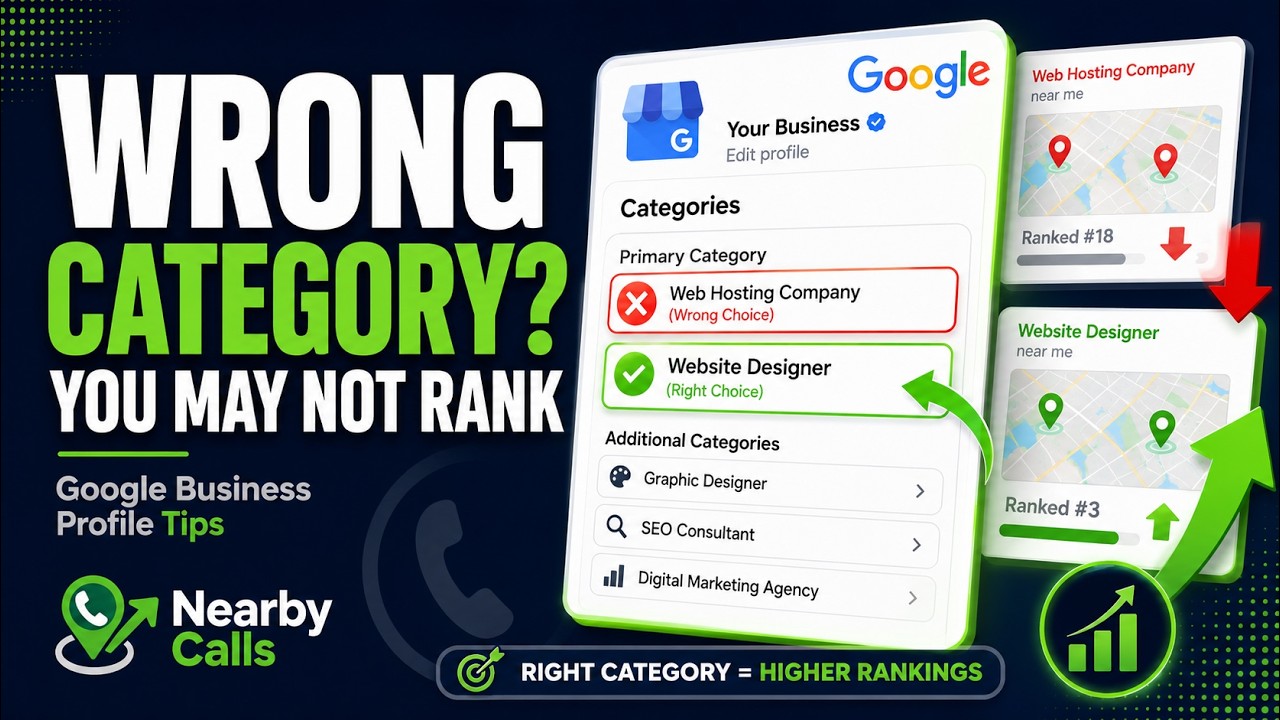
Fix Your Google Business Profile Categories to Rank Higher on Google Maps
Watch on YouTube
The relationship between website SEO and Maps ranking
Your Google Business Profile does not exist in a vacuum. We have found a direct correlation between the organic ranking of a business’s website and its Map pack performance. If your homepage is optimized for 'Plumber in Austin,' your Map profile for that location will rank higher. The algorithm uses your website to 'prove' that you are a legitimate authority in that specific geographic area.
One critical error we see is the 'link' used in the profile. For businesses with multiple locations, the profile should link to a specific location landing page, not the generic homepage. We monitored a franchise that moved all their Google links from the corporate homepage to individual city pages; they saw a 25% increase in local search visibility within a month. This satisfies the user's need for local information and helps Google’s crawlers understand your structure.
Local justifications—those snippets of text that say 'Their website mentions residential cleaning'—are pulled directly from your site’s content. If you want these to appear under your Map listing, you need to have clear, H2-headed sections on your website dedicated to those services. These justifications significantly increase click-through rates because they provide immediate proof that you offer what the user is searching for.
Page speed also matters for local search. If a user clicks the 'Website' button on your Map profile and the page takes five seconds to load, they will hit the back button. Google tracks this behavior. A high 'pogo-sticking' rate tells the algorithm that your profile wasn't a good result for that search, which can lead to a slow decline in your Map rankings over time. Keep your mobile site lean and fast.
Frequently Asked Questions
Get found, trusted, and called on Google.
Nearby Calls helps local businesses stay active on Google, collect more reviews, and generate more customer calls.
Learn About Nearby Calls